



Read in another language:
- • Why security was forced to intervene during a high-profile artist’s set.
- • The list of countries that officially boycotted the event due to political tensions.
- • The live audience’s polarized reaction to the performer taking the stage.
- • How the dramatic incident impacted the semi-final results.
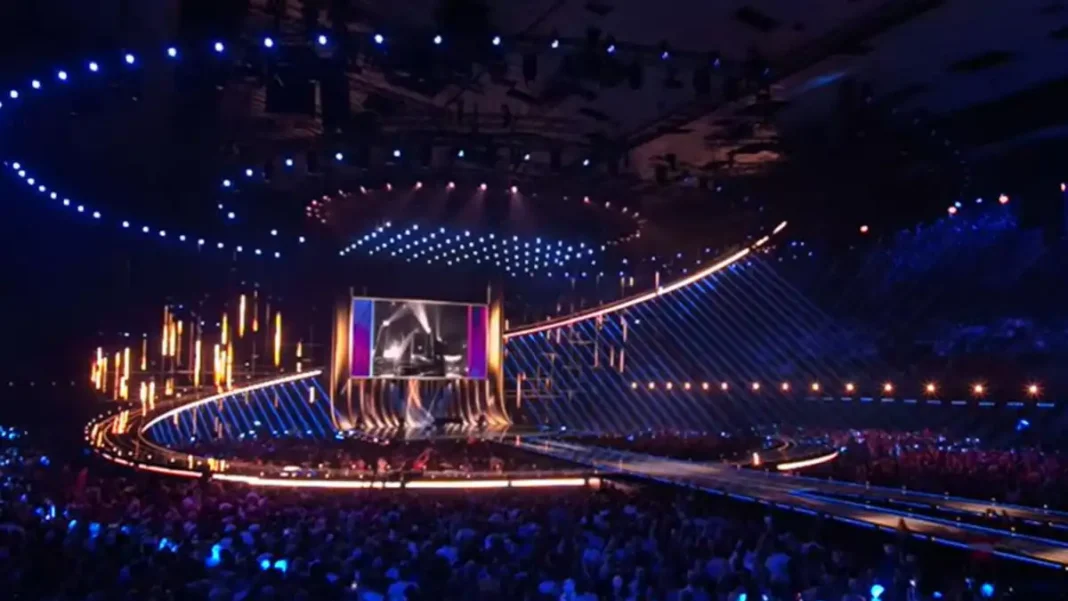
The first semi-final of the Eurovision Song Contest 2026, held on May 12 in Vienna, was anything but a quiet night of music. As a journalist who has been tracking every move of this year’s contestants, I could feel the tension inside the Wiener Stadthalle. The atmosphere wasn’t just electric with music; it was charged with fierce controversy that eventually boiled over into an open confrontation during the live broadcast, reports MODISTA.
I watched as the celebration of song briefly transformed into a protest stage the moment Israel’s representative, Noam Bettan, stepped into the spotlight. Despite organizers’ efforts to maintain ironclad security, several individuals tried to disrupt the performance with loud chants from the crowd, forcing security teams to act with lightning speed.
According to The Journal, citing the European Broadcasting Union (EBU) and host broadcasters, four people were forcibly removed from the arena during the Israeli set. It was striking to see activists screaming “Stop the genocide” precisely when the artist was trying to lock into his performance. Interestingly, if you check the official Eurovision YouTube channel, those shouts are barely audible—the sound engineers clearly worked some magic on the audio track to keep the TV presentation looking flawless.
It’s worth noting that Noam Bettan performed under unprecedented security measures. Honestly, it’s not surprising, considering five countries—Spain, Ireland, the Netherlands, Iceland, and Slovenia—had already officially declared a boycott of the event due to the military actions in Gaza. This heavy political baggage turned Israel’s participation into a literal battlefield of opinions.
Підписуйтесь, щоб не пропустити нічого цікавого! | Follow us so you don't miss anything interesting! | Subskrybuj, aby nie przegapić niczego ciekawego!
During the live stream, I caught a fascinating detail: despite the protests, there was a sea of Israeli flags being waved by fans in support. Yet, amidst that patriotic surge, a Palestinian flag also flashed in front of the cameras, highlighting the deep rift in the European public’s mood.
I’ve got to say, Noam Bettan handled it with total class. Despite the massive psychological pressure and the attempts to ruin his moment, he gave it everything he had. The gamble paid off—he secured enough votes to advance to the final. But can he maintain that momentum during the grand finale when the stakes are even higher and emotions are peaked? I’ll be watching very closely.
Scandals like this always add a bit of spice to the competition, but we shouldn’t let political slogans drown out the artistry. Eurovision has always billed itself as a project that unites, though 2026 is proving the opposite—the world is incredibly polarized, and even the stage in Vienna isn’t immune to that reality.
What’s your take—should politics be allowed to influence a song contest? Bookmark this page so you don’t miss our full review of the Eurovision 2026 Grand Final performances!