



Read in another language:
- • Key soil and air temperature benchmarks for a successful transplant.
- • Optimal windows for greenhouses, cold frames, and open soil.
- • How to tell if your plants are ready based on age and appearance.
- • Golden rules for bed prep and secrets to lightning-fast rooting.
Moving your seedlings to their permanent “home” is the ultimate test for every plant—and a major nerve-wracker for any gardener. Even the strongest sprouts can wither away if you misjudge the timing or ignore Mother Nature’s mood swings. To make sure your tomatoes don’t just survive but actually overwhelm you with fruit, you’ve got to stick to a solid plan, following the thermometer rather than just the calendar.
Success in tomato growing doesn’t start at the planting hole; it starts with patience. Rushing is a gardener’s biggest enemy, as the threat of late frosts in our latitudes often lingers longer than we’d like. Knowing exactly when to plant tomato seedlings in open ground is a puzzle that requires a balanced approach: checking the stems, prepping the soil, and, of course, stalking the weather forecast.
Let’s dive into the details of when to move those tomato seedlings into the ground or greenhouse and how to make the transition as cozy as possible for your green babies.
When to plant tomato seedlings in open ground
Tomatoes are total heat-seekers, so planting them in cold earth is like sending someone out into a blizzard in a summer t-shirt. The plant will stop growing, the roots will quit absorbing nutrients, and their “immune system” will drop to zero. Your main “green light” should be soil temperature: at a depth of about 4 inches (10 cm), the earth needs to be warmed to at least 54–59°F (12–15°C).
Підписуйтесь, щоб не пропустити нічого цікавого! | Follow us so you don't miss anything interesting! | Subskrybuj, aby nie przegapić niczego ciekawego!
It’s vital to realize that planting dates vary significantly depending on where you plan to “home” them:
- In greenhouses or stable shelters: Aim for the first half of May, provided the structure holds heat well.
- Under plastic tunnels: Usually the last decade of May, when the sun is strong enough to keep the space under the film warm.
- In open ground: The safety window only truly opens in late May or even early June. The key condition? Nighttime temperatures shouldn’t dip below 54°F (12°C).
Don’t forget about regional quirks. If you’re in a warmer climate, you might start two weeks early, but in northern or rainier areas, it’s worth the wait. Besides the weather, look at the plants themselves: they should be sturdy, sporting 8–10 true leaves and a powerful root system.
Also, keep an eye on the recommended age for your plants before the “big move”:
- Determinate (bush) varieties: 40–45 days after sprouting.
- Mid-sized varieties: 50–55 days.
- Indeterminate (tall) varieties: 50–60 days. If you’re growing early sorts without repotting, they’re ready for the ground in 55–60 days, while pot-grown seedlings can wait up to 60–70 days.
The right way to plant tomato seedlings in open ground, greenhouses, or frames
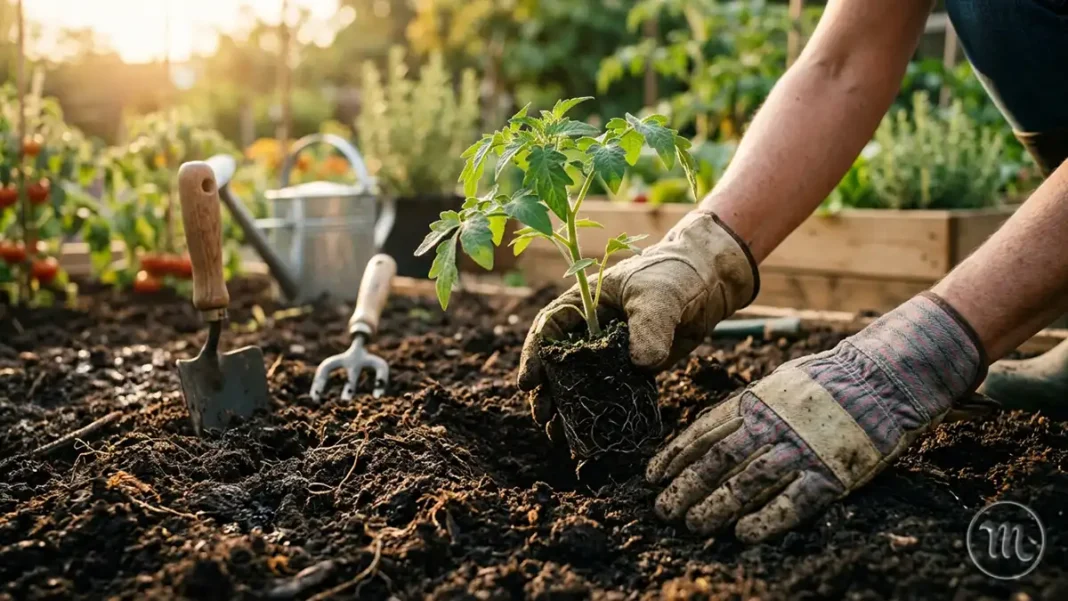
Knowing the dates is only half the battle. You need to know *how* to plant them so they don’t “freeze” in place for two weeks after the move. Growing at home is like a spa day: no wind, stable temps, and no harsh UV rays. That’s why hardening off is a non-negotiable step.
Two weeks before planting, start prepping your plants: open the windows more often and lower the nighttime temperature in the room. A week out, the containers should be “hanging out” outside—start in the shade at 57–61°F (14–16°C), then slowly introduce them to direct sunlight. For the final 2–3 days, they should spend 6–8 hours outside.
My top tip: soak your seedlings 6–10 hours before planting. A wet root ball clings together better, doesn’t crumble when removed from the pot, and guarantees faster rooting.
Should you plant in the sun or shade? The answer is easy: only sun. In the shade, tomatoes get leggy, bloom late, and catch diseases. The soil should be loose and nutrient-rich. If you didn’t prep the beds in the fall, add humus, compost, and a handful of wood ash directly into each hole. But a word of warning: never plant tomatoes after potatoes—they share diseases like blight that will wipe out your crop in a heartbeat.
The perfect time for the procedure is a cloudy day or in the evening after sunset. If your tomatoes have grown too tall and look like thin vines, don’t sweat it: plant them “lying down” at an angle, burying part of the stem. This triggers extra root growth, making the bush much stronger.
Once the seedlings are in the ground, your mission isn’t over:
- Watch the forecast: if it’s predicted to drop below 41°F (5°C), cover your beds with garden fabric or film immediately.
- In the greenhouse, don’t let it overheat. If it hits 86°F (30°C), the pollen becomes sterile, and your fruit simply won’t set.
- Use mulch. Straw or sawdust on the beds is a lifesaver—it keeps weeds down and locks moisture in the ground.
My Opinion:
Ladies, remember the golden rule: it’s better to plant a week late than one day too early and lose everything to frost. Tomatoes are total sun-lovers that don’t forgive rushing. I always suggest waiting until the night air feels soft, not just warm during the day. Your patience will definitely pay off with a juicy, sweet harvest!
Advice from MODISTA
- Try using succinic acid during the first watering after planting—it’s a powerful anti-stress boost that helps roots get settled in new soil fast.
- Always plant in the evening; it gives the plants a whole night to toughen up before facing their first round of intense daytime sun.
- Don’t go overboard with nitrogen fertilizers right after the move, or you’ll end up with massive green bushes and zero fruit.
Do you have a “secret date” your family always sticks to for planting? Share this guide with your gardening bestie so everyone gets a royal harvest this year!
ℹ️ REFERENCE
Planting dates for vegetable crops depend on climatic zones and current weather conditions, which are determined by agrometeorological observations. You can learn more about crop rotation rules and the requirements for growing nightshades in specialized literature or professional resources. 🌐