



- • The crucial winter warmup secret that saves your transmission from instant wear and oil starvation.
- • Why the habit of constantly shifting gears in heavy traffic slowly kills internal mechanisms.
- • The real service intervals for changing fluid, despite manufacturer claims of “lifetime” lubrication.
- • Major taboos for continuously variable transmissions: how towing and off-roading turn your car into a paperweight.
Read in another language:
The CVT (continuously variable transmission) is an incredibly delicate and sophisticated piece of engineering. When treated with respect, it delivers a beautifully smooth ride and lasts for years. But treat it carelessly, and it’ll demand a catastrophic overhaul before your third scheduled maintenance visit. I’ve tested countless cars equipped with this type of transmission, and I’ve noticed that the vast majority of failures boil down to one thing: human error, reports MODISTA.
In this technical breakdown, I’ll dive straight into exactly how drivers inadvertently destroy this expensive unit ahead of its time. I’ll also share a few simple, highly effective habits that will dramatically extend your CVT’s lifespan and save you from eye-watering repair bills at the mechanic.
The Anatomy of a CVT: Key Entities
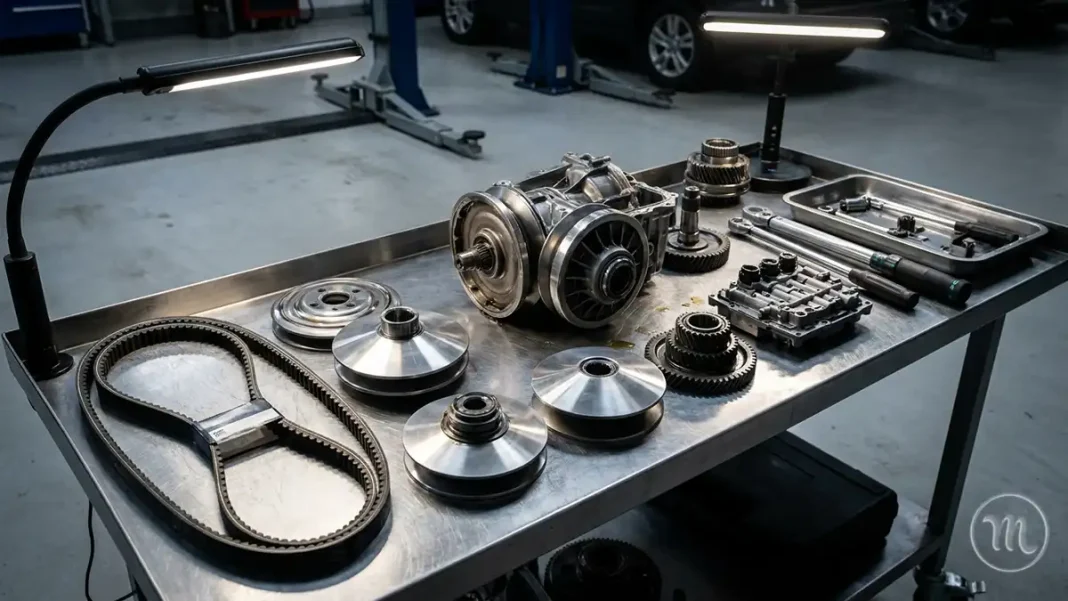
To fully grasp what’s going on under the hood, we need to understand the critical components keeping the system alive:
- Valve Body and Solenoids — The brains controlling fluid pressure throughout the system.
- Drive Belt (or Chain) — Transmits torque directly between the pulleys.
- Conical Pulleys — Constantly adjust their diameter to deliver seamless, stepless shifting.
- Transmission Fluid (CVT Fluid) — A highly specific lubricant designed to prevent belt slippage.
- Heat Exchanger (Cooling Radiator) — Keeps the transmission from reaching critical overheating temperatures.
- Oil Pump — Generates the operational pressure, which is heavily reliant on fluid viscosity.
Aggressive Off-the-Line Starts and Chilly Mornings
A CVT absolutely hates aggressive, sudden acceleration from a dead stop. This issue gets significantly worse during winter when temperatures drop well below $0^\circ\text{C}$. After sitting out overnight in freezing weather, the transmission fluid settles into the oil pan, thickens up, and loses its natural flowability.
Підписуйтесь, щоб не пропустити нічого цікавого! | Follow us so you don't miss anything interesting! | Subskrybuj, aby nie przegapić niczego ciekawego!
That’s why, before you start driving aggressively, I strongly advise letting the engine and transmission idle for a bit. Don’t just slam the gas pedal into the floor right away. When you ignore this rule, the metal components inside the CVT experience severe oil starvation for those first few crucial minutes. The result? Accelerated wear and scuffing on the pulleys, which inevitably paves the way to total transmission failure.
The Traffic Jam Shifting Habit
Automotive forums are packed with advice claiming that when you’re stuck in bumper-to-bumper traffic, you should constantly shift your gear selector from Drive (D) to Neutral (N). Honestly? I don’t recommend this at all, and here’s why.
If traffic is completely dead and you’re sitting still for a long time, it makes sense to shift into Park (P). This keeps the car completely stationary if you get distracted by your phone and let your foot slip off the brake. But during brief stops at red lights or in slow, crawling traffic, it’s much better to leave the selector in Drive and stop messing with it.
Think about it: every time you shift into Neutral, the system’s operational fluid pressure drops instantly. Once you shift back into Drive, there’s a slight delay before pressure builds again, depending on internal mechanical inertia. If you aggressively hit the gas the second traffic moves, the belt will slip and slide right across the pulleys. No transmission can survive that kind of abuse for long. In my experience, after shifting from N to D, you need to wait at least two seconds for the hydraulic system to equalize pressure before smoothly accelerating.
The Dangerous Myth of “Lifetime” Fluid
Even though many modern car manufacturers explicitly state in their service manuals that CVT fluid is designed to last the lifetime of the vehicle, I highly recommend changing it every 30,000 to 50,000 km (roughly 18,000 to 30,000 miles).
If you don’t, normal wear and tear creates microscopic metal shavings that circulate through the system, slowly choking the valve body and solenoids. Regular, timely maintenance and replacing both fine and coarse filters will keep your CVT thriving. This is especially true if you haven’t outgrown your inner Formula 1 driver and still prefer a fast, aggressive driving style.
Heavy Towing and Excessive Overloading
Towing stranded vehicles, heavy trailers, or campers with a CVT-equipped car is a risky, highly discouraged gamble. This intense load forces the transmission to deal with massive amounts of torque that the drive belt simply wasn’t engineered to handle. This triggers a rapid chain reaction of wear on all moving parts, stretches the chain, and causes the clutches to burn up from overheating.
Treating a Crossover Like a Rugged Off-Roader
Marketing brochures love to pitch CVT crossovers as rugged, unstoppable off-road beasts. Don’t fall for the hype. CVTs panic when subjected to prolonged wheel spin in thick mud, deep sand, or heavy snow. If there’s a serious risk of getting stuck, it’s best to steer clear entirely.
Otherwise, you’re guaranteed to overheat the transmission due to a lack of airflow through the heat exchanger. When a CVT repeatedly overheats, the differential and conical pulley bearings take the heaviest hit. While replacing them isn’t impossible, your mechanic will have to drop the entire transmission and pull it apart piece by piece. To avoid this headache, remember: a CVT car is built for comfortable city commuting and smooth highway cruising, not for conquering wild off-road trails.
What to Do in a Worst-Case Scenario
Towing a CVT vehicle itself is only acceptable in extreme emergencies. Even then, the engine must be running and the shifter must be in Neutral (N) so the oil pump can keep generating pressure to lubricate the moving parts.
If the engine is seized or dead, you cannot tow it regularly. The vehicle must be transported using a wheel lift with the drive wheels completely off the ground. Better yet, just call a flatbed tow truck right away. This protects the cones from getting deeply scuffed by rotating “dry” without lubrication.
Advice from MODISTA
- Always warm up your transmission in the winter for at least 5–7 minutes, smoothly cycling the shifter through all gears while holding the brake before setting off.
- Shorten your CVT fluid replacement interval to 40,000 km if you deal with daily city gridlock or love brisk acceleration.
- Avoid towing other vehicles or hauling heavy loads entirely; if your car breaks down, always opt for a flatbed tow truck.
How does your transmission handle the bitter winter cold? Share this guide with your friends or send it to someone who just bought a brand-new crossover!
MODISTA Daily MODISTA Daily MODISTA Daily
ℹ️ REFERENCE
Continuously Variable Transmission (CVT) is a type of single-speed automatic transmission that can change seamlessly through a continuous range of effective gear ratios. Detailed technical specifications, history, and the mechanics behind different CVT designs can be explored in depth on the free encyclopedia. 🌐