



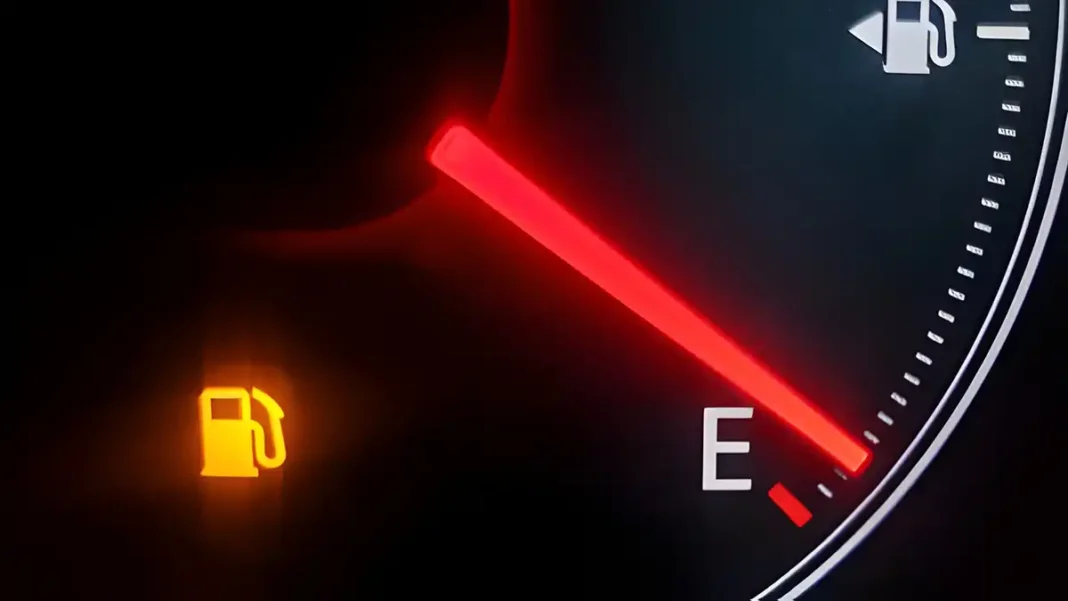
When the yellow indicator flashes on the dashboard, the age-old question arises: will this “bottom” be enough to reach the nearest gas station? We found out what unstated driving range manufacturers build into the tank and why you shouldn’t constantly let your car get into this state, as reported by MODISTA.
It’s a familiar scene for every driver: you’re rushing to run errands, and that worrying, orange gas pump icon suddenly lights up on the dashboard. I’ve often caught myself thinking, “Oh no, how much further can I go?” This situation always causes a slight flutter, as no one wants to become the subject of a sad story on the roadside. Is such driving safe for the car, and how many reserve kilometers are truly at your disposal? Let’s try to figure it out.
How Much Fuel Remains When the Indicator Activates
All modern cars have a system that warns you in advance about the minimum fuel reserve. And it’s not just an “empty” tank, but a well-thought-out reserve so you have time to safely drive to a gas station. Typically, as soon as the indicator lights up, there is still enough volume in the tank to drive for a few dozen kilometers.
However, the exact figures are very individual. They depend not only on the make and model but even on the specific modification of your car.
On average, between 4 to 8 liters of fuel remain in the tank after the light comes on, although this figure can vary greatly.
Підписуйтесь, щоб не пропустити нічого цікавого! | Follow us so you don't miss anything interesting! | Subskrybuj, aby nie przegapić niczego ciekawego!
Here are a few examples:
- Toyota: often has the largest reserve — a minimum of 9–10 liters.
- Lada (some models): 7–8 liters.
- Hyundai Solaris, Kia Rio: about 7 liters.
- Volkswagen Polo: from 7 to 8 liters.
- Renault Duster: no less than 7 liters.
- Renault Logan, Lada Largus: approximately 5 liters.
- Lada Granta, Lada Kalina: 8 liters.
- Lada Vesta: from 7 to 8 liters.
- Lada Niva Legend, Niva Travel: about 9 liters.
Real Driving Range: How Many Kilometers You Can “Squeeze Out”
The distance you can cover on this reserve is determined not only by its volume but also by many other factors:
- Fuel Consumption: surprisingly, but this is the main factor.
- Driving Style: sharp acceleration and braking will “eat up” the reserve faster.
- Driving Conditions: in the city with frequent stops, consumption is higher than on the highway.
- System Usage: turning on the air conditioner, a powerful audio system, or heating also consumes energy, and therefore increases fuel consumption.
For most passenger cars, the driving range on the “light” averages from 50 to 100 km, provided you maintain calm and consistent driving.
- For standard sedans, this range is usually closer to 50–80 km.
- Cars with economical hybrid engines or large tanks can drive for 90–120 km.
Even 100+ km is a completely realistic figure for certain models, especially when driving on the highway without sharp maneuvers.
Approximate driving range for some models:
- Hyundai Solaris, Kia Rio: up to 100 km.
- Volkswagen Polo, Skoda Rapid, Lada Granta, Lada Kalina, Lada Vesta: no less than 100 km and even more.
- Renault Duster, Renault Logan, Lada Largus, Lada Niva Legend, Niva Travel: about 90 km.
Why Experts Advise Against Driving on Minimum Fuel
Despite such a welcome reserve, constantly ignoring the indicator is a bad habit that can be costly. Experts are unanimous: driving with the light on creates several risks for your car.
Overheating and Failure of the Fuel Pump
In modern cars, the fuel pump is usually located directly in the tank. It is submerged in fuel, which acts as a coolant. When the fuel level becomes very low, heat dissipation worsens. In hot weather, this can critically overheat the pump and lead to its damage. And repairing or replacing this unit is not a cheap pleasure.
Sucking Up Dirt and Impurities
Over time, sediment, microscopic impurities, and even condensate (water) inevitably accumulate at the bottom of any tank. When the fuel level is minimal, the pump begins to actively “grab” this dirt. This, in turn, can:
- Clog the fuel filter.
- Reduce the life of the pump.
- Damage sensitive injectors or the catalytic converter.
The Pump Running “Dry”
If you completely empty the tank, the pump will suck in air and start working without lubrication and cooling. This is called running “dry,” and it quickly renders the pump useless. It is best not to let it get to this point.
Habits That Will Preserve Your Car
To avoid unnecessary repair costs and unpleasant situations on the road, you should adhere to a few simple rules.
- Fill up early. Don’t wait for the light to come on. If you have a long journey ahead and questionable gas stations, stop at a reliable gas station as soon as the level approaches a quarter of the tank.
- Remember the conditions. Keep in mind that the driving range is always shorter in the city than on the highway. Plan your fill-ups based on real fuel consumption.
- Monitor the filters. Regular replacement of fuel filters significantly reduces the risk of system clogging, even if you are occasionally forced to drive on a low fuel level.
Conclusion: The Indicator as a Reminder, Not a Call to Extremes
The lighting up of the low fuel indicator is certainly not a cause for panic. It is a signal that the manufacturer has given you a reserve of time (and kilometers!) to safely reach a gas station. On average, this reserve allows you to cover from 50 to 100 km.
However, you should treat this reserve as an emergency measure, not a constant practice. Regularly ignoring this warning can lead to expensive repairs to the fuel system. Remember that filling up on time is always cheaper and safer than calling a tow truck and replacing the pump.