



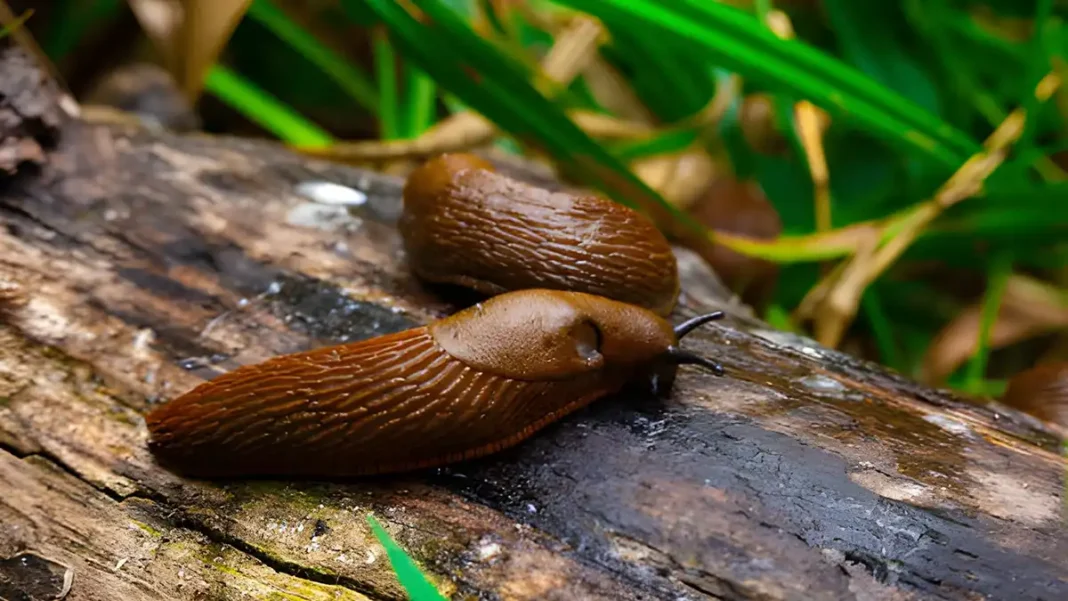
If you noticed that slugs staged a real feast in your garden beds this summer, you should not postpone fighting them until next spring. As a gardener, I advise: you need to act immediately, and the best period for this is autumn. Why?
The thing is that in October, pests are actively preparing for wintering. They form so-called clutches — they lay eggs deep in the soil, under a layer of mulch, or in plant residues. This is their insurance for the future. If we act now, we will destroy not adult individuals, but an entire new generation even before its birth. This is a strategic, deep approach that guarantees: in the spring, your young plants will no longer become food for voracious mollusks.
Three Key Steps to a Clean Plot
For autumn cleaning to be as effective as possible, it is necessary to carry out complex work, consisting of three sequential stages.
Complete Territory Cleanup: Removing Shelter
First of all, we need to deprive the pests of their “winter homes.” Collect absolutely everything that is lying on the beds and around them:
- Fallen leaves.
- Mown weeds.
- Remains of old vegetable crops (tops, roots).
- The entire layer of mulch.
It is in these materials that slugs like to make their clutches, which, by the way, are quite difficult to see. If you leave these shelters, the eggs will safely overwinter, and in the spring, countless new pests will hatch from them.
Підписуйтесь, щоб не пропустити нічого цікавого! | Follow us so you don't miss anything interesting! | Subskrybuj, aby nie przegapić niczego ciekawego!
Personal advice: I never advise sending such affected debris immediately to the compost heap. It is better to burn it or bury it separately at great depth to avoid the spread of larvae throughout the plot.
Deep Soil Breathing: Loosening
After the territory is cleared, it is time to tackle the soil. Deep loosening of the beds is not just aeration. This is our way to “lure out” slug eggs from the deep layers to the surface.
When clutches rise to the top, they become more vulnerable:
- They are easy to destroy during further processing.
- They are not protected from winter frost and cold.
I always advise carrying out this procedure exclusively in dry weather when the soil does not stick to the tools. By the way, loosening also perfectly improves aeration (air exchange) and helps get rid of other pests that overwinter underground.
Heavy Artillery: Superphosphate Against Clutches
And here is the main, key stage of our autumn operation — the application of dry superphosphate. This mineral preparation performs a dual function.
How to do it:
- Scatter the fertilizer over the very surface of the earth.
- Application rate: approximately 40 g per 1 square meter.
Important nuance: there is no need to incorporate superphosphate into the soil! Its action against slugs is effective precisely when the granules remain on top. It virtually “burns” and dehydrates the delicate slug eggs, giving them no chance of survival.
But that’s not all! Superphosphate is also an excellent mineral fertilizer. Over several winter months, it will gradually dissolve, and in the spring, the soil will be saturated with phosphorus. This is a critically important element that significantly strengthens the root system of your future crops and prepares them for active growth.
Waiting for the Result: Reliable Protection Until Spring
After such a thorough autumn treatment, the plot can be safely left alone until the start of the new season. The combination of the fertilizer’s action and natural winter frosts guarantees that the slug clutches will be completely destroyed.
In the spring, when most gardeners are just beginning to fight the first mollusks, your garden beds will already be reliably protected. We eliminated the enemy before it even had a chance to be born!
Additional Tactical Tricks for Protection
To maximize protection, remember a few more important points:
- Control the compost: Slugs love to hide in compost heaps. Check them regularly and mix them up so that pests do not settle comfortably for the winter.
- Avoid excessive moisture: Excessive soil wetting in autumn attracts mollusks. Try not to overwater the beds before the onset of cold weather.
- Create “live” barriers: When planning spring plantings, set aside space for crops that naturally repel slugs. This can be garlic, sage, rosemary, or marigolds.
- Spring prevention: At the beginning of the season, be sure to carry out a preventive inspection. You can set up a few simple beer traps or superficially loosen the soil again.
Autumn treatment of the plot is not just a one-time prevention. It is a strategic, far-sighted measure that lays the foundation for soil health, its fertility, and, undoubtedly, for your abundant harvest next year.