



In this article, you’ll learn:
- Why dart frog poison is considered more complex than snake venom.
- Which exact dose of batrachotoxin can send 20 people to the afterlife at once.
- The paradoxical link between the Golden Poison Frog and the toxic pufferfish.
- The shocking truth about where these amphibians actually get their toxicity.
Poison has always been seen as the weapon of the treacherous, but in the wild, it’s simply a matter of survival. When you’re a tiny creature in the aggressive environment of the tropics, every means of defense is justified. Dart frogs chose batrachotoxin — one of the most powerful organic poisons on the planet — turning their skin into a deadly barrier for any predator, reports MODISTA.
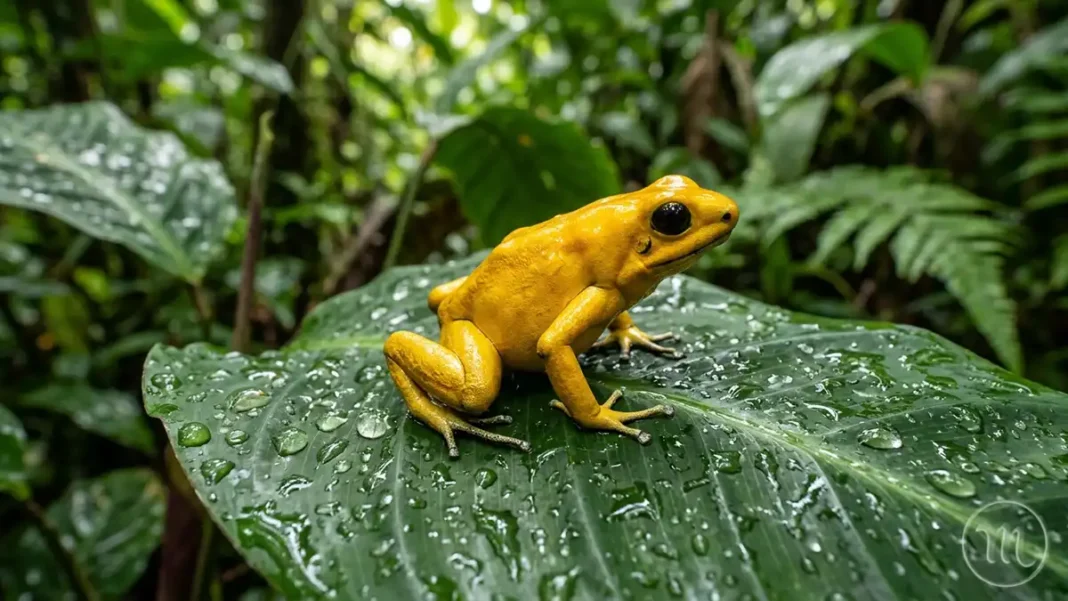
You only need a quick glance at the members of the Dendrobatidae family to understand their strategy. These microscopic inhabitants of the humid jungles are way too small to fight, so they decided to “go toxic” at a level unreachable for others. Their bright coloring isn’t decoration; it’s a screaming warning: “Don’t touch, or this will be the last thing you ever do.”
Chemical Weapons Without an Antidote
Interestingly, the poison of these amphibians is non-protein in nature. This is the main difficulty compared to snake toxins, as creating an effective serum in such a case is incredibly hard. Scientists have even identified a separate group of substances, naming them batrachotoxins. The name comes from the Greek word “batrachos,” which literally means “frog.”
Among all its relatives, the real champion is the Golden Poison Frog. Its mucus is so saturated with death that a single drop is enough to put twenty grown men in the grave. You don’t even need to swallow this substance — the smallest scratch on your skin is enough. The lethal dose for a human is a measly 2 mcg per kilogram of weight, while one small individual accumulates between 1000 and 2000 mcg of this substance.
Підписуйтесь, щоб не пропустити нічого цікавого! | Follow us so you don't miss anything interesting! | Subskrybuj, aby nie przegapić niczego ciekawego!
Eight Minutes to the Finale
How exactly does this mechanism work? Once it enters the bloodstream, the toxin instantly attacks the cells’ sodium channels. It strips the body of its ability to transmit nerve impulses, causing a kind of short circuit. Muscles start contracting erratically, the heart rhythm turns into chaos, and the person dies in horrific convulsions within about 8 minutes.
Science has found a theoretical antidote, and you won’t believe what it is. It turns out that the poison of the famous pufferfish can block the action of batrachotoxin! It acts in the opposite way — it closes the sodium channels. But don’t celebrate just yet: the “fight fire with fire” principle only works here in theory. In practice, the patient will still die; instead of convulsions, they’ll face total paralysis. The balance of these two killers exists only on researchers’ paper.
Diet Secret: You Are What You Eat
The most striking discovery was that the Golden Poison Frogs themselves can’t produce the poison on their own. So where does this killing power come from? The phrase about being what we eat works 100% here. Batrachotoxins enter the frog’s body along with its food. It accumulates them in special glands and excretes them through the skin.
If you change the menu for these amphibians, they turn into ordinary, harmless creatures. The experience of keeping poison frogs in terrariums proved it: without their specific jungle diet, they become completely safe. Scientists searched for that “source of evil” among insects for a long time, and found the answer where they least expected — while studying birds in New Guinea.
From Beetles to Bird Feathers
The Blue-capped Ifrita and the Hooded Pitohui are the only birds in the world whose feathers are poisonous. As it turns out, they, like our frogs, love to feast on beetles from the Melyridae family. These insects are true cosmopolitans and also live in the forests of South America. It’s these little “toxics” that the Golden Poison Frogs happily crunch on, building up their deadly collection.
Why don’t the eaters themselves die from such a meal? It’s all about immunity. The batrachotoxin content in one beetle is tiny, but over years of evolution, birds and frogs have learned not just to digest it, but to concentrate it for their own protection. Thus, the little frog is merely a reservoir for poison that was carefully gathered for it by forest insects.
MY OPINION:
I’ve always believed that nature is the best thriller writer. Just imagine: a frog that’s safe in captivity becomes a serial killer only because of its lunch choices. It just goes to show that looks can be deceiving, and real danger is often hiding behind bright colors and fragile forms.
Advice from MODISTA
- If you’re traveling through the tropics, never touch bright animals, no matter how cute they seem.
- Remember that bright colors in nature are almost always a “stop” signal.
- Study the biology of the places you’re planning to visit; knowledge sometimes saves lives.
Did you know before that a frog’s poison depends on its daily menu? Share this amazing story with friends who love exotic nature and interesting animal facts!
ℹ️ REFERENCE
The Golden Poison Frog (Phyllobates terribilis) is a species of tailless amphibian that lives in a limited area of the Pacific coast of Colombia. It’s one of the most toxic animals on Earth, listed as a vulnerable species due to its small habitat. You can learn more about this species and its ecology in encyclopedia pages. 🌐