



In this article, you’ll learn:
- How to correctly place your photo on the vision board to activate its energy.
- What each of the nine feng shui sectors represents and which dreams to stick there.
- A step-by-step plan for creating a powerful visualization board that attracts your desires.
- The secrets that help make a vision board truly effective.
I’ve researched ancient Chinese techniques to understand how to properly arrange your aspirations on a visualization board, turning it into a powerful magnet for making dreams come true. Many of us create vision boards full of inspiration and hope but don’t always get the expected results. Perhaps the reason lies not in the strength of your desire, but in how exactly you organize the space of your dreams, reports MODISTA.
I’ve always wondered why some vision boards “work” while others remain just pretty collages. It turns out that according to Chinese feng shui rules, every detail matters—from the placement of your photos to the choice of images for each sector. Let’s figure out together how to set your board for success and make the Universe listen to your deepest aspirations.
Feng Shui and Your Visualization Board: Basics of Successful Activation
If you want to create a vision board that truly attracts changes into your life, you should pay attention to feng shui principles. It’s not just a chaotic sticking of pictures, but a whole system where each element has its place and meaning. The main idea is to synchronize your dreams with energy flows so they can manifest freely in reality.
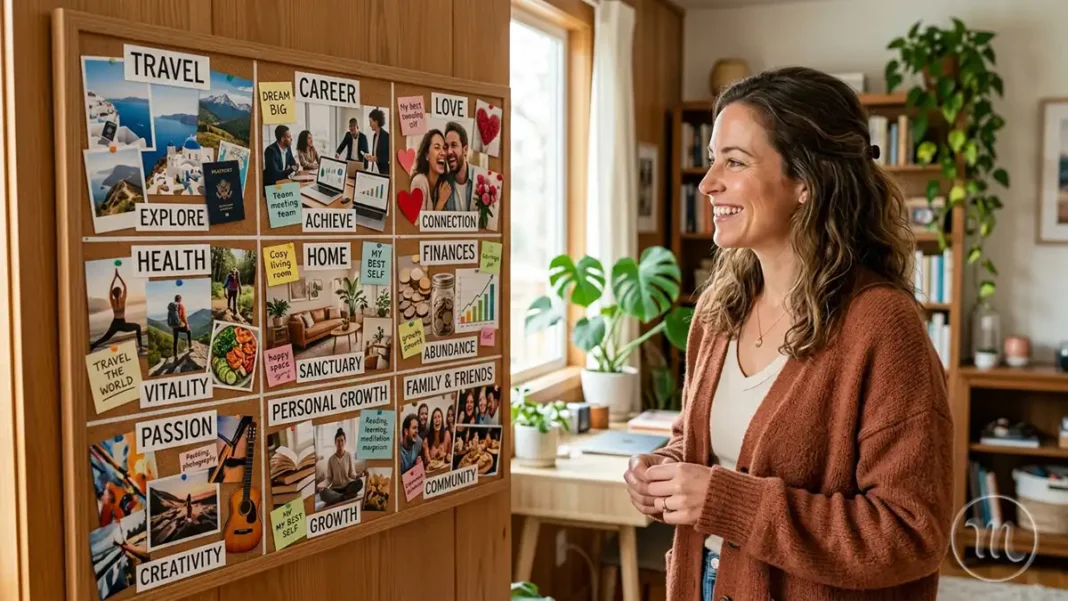
First of all, be sure to place your photo in the center of the board. It should be a high-quality shot where you’re smiling, radiating positive energy, and importantly, not wearing sunglasses. Your eyes are the mirror of the soul, and they must be open to the Universe. After that, visually divide the board into nine equal squares, as if playing “Tic-tac-toe.” Each of these squares is responsible for a certain area of your life and requires appropriate images or inscriptions.
Підписуйтесь, щоб не пропустити нічого цікавого! | Follow us so you don't miss anything interesting! | Subskrybuj, aby nie przegapić niczego ciekawego!
Vision Board Sectors According to Feng Shui: What to Put Where
Dividing the board into nine sectors is a key moment. Each has its own energy and corresponds to specific aspects of your life. It’s important to carefully select images and wording so they most accurately reflect your aspirations in the corresponding zone.
- Top Left Square: Wealth, Abundance. This is where we stick everything that symbolizes financial success and prosperity. These can be images of money, bank cards, or luxury items you dream of buying. My personal tip is to add an affirmation like: “Money loves me and is attracted to me like a magnet.”
- Top Center Square: Fame, Leadership, Authority, Recognition. Here is the place for your ambitions, achievements, and public success. Photos of awards, certificates, prominent figures you admire, or symbols of power and influence.
- Top Right Square: Love, Relationships, Marriage. This sector is dedicated to harmony in your personal life. Images of happy couples, romantic moments, and symbols of love (hearts, flowers). If you dream of marriage, you can place a photo of a wedding or rings.
- Middle Left Square: Family. Your family is the foundation. Place photos of happy families, images of a cozy home, and family celebrations here. If you’re dreaming of an addition to the family, add images of children.
- Central Square (Your Photo): Health, Happiness, Harmony. This sector is the heart of the board. Your photo in the center symbolizes you within this flow of dreams. Add images associated with health, vital energy, inner peace, and joy.
- Middle Right Square: Children, Creativity. If you dream of children, this is your sector. It’s also the place for all your creative ideas, hobbies, and projects. Images of drawings, musical instruments, dancing, or any form of self-expression.
- Bottom Left Square: Knowledge, Self-development, Wisdom. This sector is for those who seek new knowledge, education, and personal growth. Photos of books, diplomas, universities, or places where you’d like to study or develop.
- Bottom Center Square: Career. Your professional ambitions and successes. Images of your desired job, office, business meetings, and successful projects.
- Bottom Right Square: Travel, Entertainment, Leisure. Here we stick everything related to your dreams of travel, adventure, vacation, and new impressions. Photos of countries, cities, beaches, or mountains where you want to go.
By the way, folk tales often mention the mystical power of the broom, which has its own secrets from our ancestors, symbolizing the cleansing of space and the attraction of well-being. This wisdom, while not part of the vision board itself, highlights the deep connection between everyday life and esotericism.
Ten Steps to Creating a Dream Board That Works
Creating a vision board is an exciting process that you can turn into a real ritual. Here’s a step-by-step plan to help you create a powerful tool for visualization:
- List your goals and prioritize them. Before grabbing scissors and glue, take a piece of paper and brainstorm. Write down absolutely all your dreams and goals, regardless of their scale. It could be something grand, like wanting to be healthy and strong, learning to meditate, or traveling with your family. Or something small but equally important, like buying a new vacuum cleaner. Once you’ve offloaded all your thoughts, review them, set priorities, and form a new, structured list. This is how the most important things will find their place on the board.
- Create the basic board structure. This step, while not strictly mandatory, greatly simplifies systematization. Divide your base (cardboard, cork) into nine squares as discussed, and label each with the corresponding life area: “Health,” “Education,” “Family,” etc. For greater visual clarity and energy activation, you can assign a color to each section and even use different fonts for labels.
- Write your goals and ideas on the board. Even if you plan to cover these inscriptions with images later, the draft text helps formulate your aspirations as clearly as possible. It’s like thinking on paper, allowing you to crystallize your desires. It’s important that there isn’t much text, only key phrases that reflect the essence of your dream.
- Find the right images and words. Old magazines, brochures, or even the internet work best for this. Look for and cut out photos, drawings, and inscriptions that don’t just match your goals but also evoke an emotional response. Use everything you like: colors, interesting images, words. I often cut out much more than I’ll eventually need because having a choice is important. If I can’t find the perfect image for a certain goal, I sit at the computer and print the visual I need. My own goal boards contain a mix of magazine clippings, internet printouts, and even my own drawings. This stage can be great family fun—give the kids scissors, and you’ll be surprised by their creativity!
- Sort and organize images and words. This stage can be done while cutting or after. However, placing visuals in the correct sections immediately helps you see what’s missing for the full picture.
- Edit and finalize the board. You’re halfway there, and now it’s time to narrow down the number of images and words and decide on their final placement. Determine what resonates with you the most and what can be set aside.
- Glue the images. Start with the base layer—large images or background colors that set the tone for each sector. Then complement them with smaller details, creating a layered composition.
- Add your own words, logos, or sketches. Use not only cut-out words but also markers, pens, and pencils. Unleash your imagination! It’s very important to highlight the main things, perhaps circle key phrases or add personal symbols.
- Choose the right place for the board. Your dream board should be in a prominent place where you see it regularly. This could be a wall next to a mirror, the space above your desk, or even a closet door. Some people prefer hanging the poster on the fridge with magnets. The key is that it constantly reminds you of your goals.
- Review your dreams daily. This is the most important step. At least once a day, stop by the board and look closely at the images and text. Imagine how you’ll feel when these dreams come true. Think about what small steps you can take today to get closer to what you want. It’s regular visualization and action that turn the board from a simple collage into a powerful manifestation tool.
Remember that a vision board isn’t a magic wand, but a tool that helps focus your energy and intentions. It works together with your actions and belief.
My opinion:
I’ve always been a fan of visualization, but it was the feng shui system that gave my vision board new meaning. When I first learned about these nine sectors, it was a real revelation. Now I know for sure that I’m not just sticking pictures, but creating a powerful energetic magnet that helps me focus on my goals and feel like they’re already on their way to me.
Advice from MODISTA:
- Choose images that evoke strong positive emotions. The brighter you feel joy looking at them, the stronger the visualization energy will be.
- Don’t be afraid to experiment with colors and textures in each sector, as they also affect the energy of the space.
- Update your board regularly: when a dream comes true, remove its image and replace it with a new one, or simply thank the Universe for the realization.
Have you already tried creating a vision board using feng shui rules? Save this article so you don’t lose these valuable tips, and share it with a friend who also needs some magic to make dreams come true!
Join our community where comments are open just for you!
ℹ️ REFERENCE
Feng shui is an ancient Chinese metaphysical science and art of space organization aimed at achieving harmony with the environment. It studies “chi” energy flows and their impact on human life, offering principles for the arrangement of objects, buildings, and even thoughts to attract prosperity, health, and happiness. A vision board integrated with feng shui principles uses these energetic laws to enhance visualization and speed up the realization of dreams. 🌐