



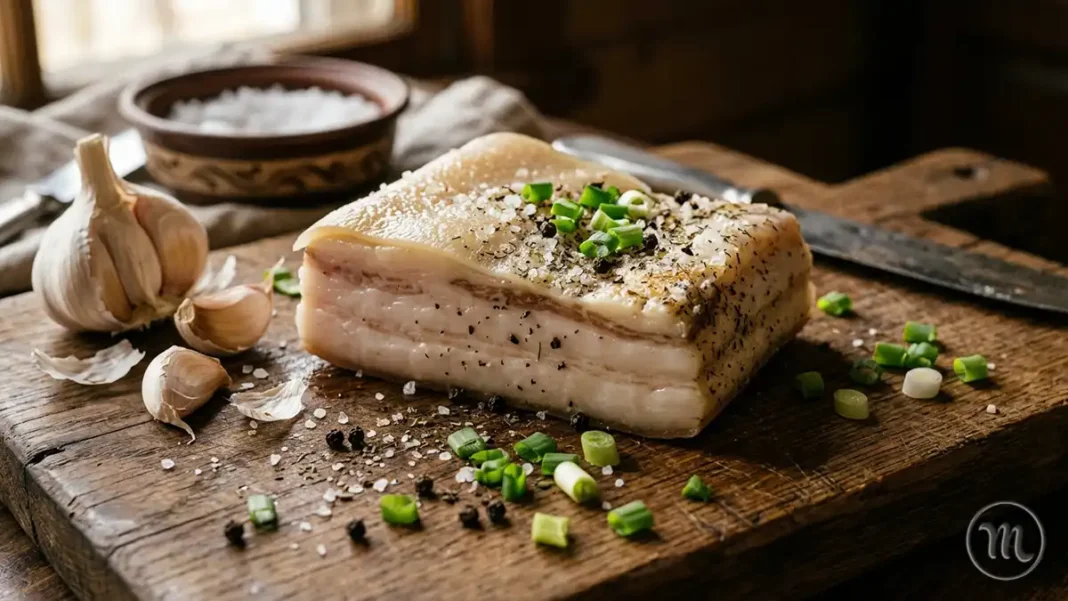
Even though my family and I live in a private house, we don’t keep our own pigs, so like most of you, my dears, I buy my salo at the market. However, salting is my personal ritual that I don’t trust anyone else with.
I used to often face a frustrating lottery: it’s like I don’t change the recipe, I salt it with all my heart, yet the result is different every time. Sometimes the skin melts in your mouth, and other times it feels like a piece of rubber or an old shoe sole. The thing is, when buying from a vendor, we never know 100% how old the animal was, its breed, or how diligently the carcass was seared with fire.
The Secret to the Perfect Choice and Rescuing a Bad Purchase
Of course, the best option is not to fix mistakes but simply not to make them. It’s what I do: whenever I go to the market, I always take a regular toothpick or a match with me. This is my proven expertise method. It’s enough to gently try to pierce the skin of the raw piece. If the match goes in like butter — congrats, you’ve found the perfect product that’ll be tender no matter what. But what if you’ve already brought the salo home and it turns out to have “character”? We’re going to save the situation!
How to Salt Salo So the Skin Comes Out Soft
To fix the situation and make the skin pliable, I use the local boiling method. This allows for softening the toughest fibers without ruining the structure of the entire piece.
Step-by-step preparation instructions:
- Take a deep frying pan and pour just a little water into the bottom — the level should be just enough to cover only the skin itself, without touching the meat or the main layer of fat.
- Place the pan on the fire and wait for it to boil.
- Place the piece of salo (or several parts if it’s large) skin-side down directly into the water.
- Boil the skin for a certain amount of time. If the pig was young, 5 minutes is enough. If you got a piece from an older animal, you’ll have to wait 15–20 minutes.
- Keep an eye on the process: remember that the bottom layer of fat in contact with the water will also be cooked. Its taste will change to “boiled,” which is a small price to pay for soft skin.
After this procedure, you can move on to your usual salting — hot or cold. However, I want to warn you about the dry method. Since the skin has already absorbed moisture during boiling, regular salting might be tricky. The salo in the fridge can quickly “suffocate,” become slippery, or develop a strange aroma. My tip: if you chose the dry method after boiling, keep such a product exclusively in the freezer.
Підписуйтесь, щоб не пропустити нічого цікавого! | Follow us so you don't miss anything interesting! | Subskrybuj, aby nie przegapić niczego ciekawego!
There’s also another folk method I’ve heard of, but haven’t personally tested in my kitchen yet. Some suggest wetting the skin with water, heavily sprinkling it with baking soda, and leaving it in the fridge overnight. In the morning, the soda is thoroughly washed off before salting. They say the alkaline environment softens the tissues quite well, but the pan-and-water method seems more reliable and faster to me.
MY OPINION:
I always believe it’s better to spend 10 minutes checking the product with a match at the market than to stand over the stove later. But if it’s already happened — boil the skin without fear, because there’s nothing worse than delicious salo that’s impossible to chew because of a tough “wrapper.”
Advice from MODISTA
- Choose salo from the back or sides — the skin there is usually thinner and softer than on the belly.
- Always pay attention to the skin’s color: it should be light, without stubble, and have a pleasant aroma of singed straw.
- Store salted salo in parchment paper instead of plastic so it can “breathe.”
Have you ever bought salo that was impossible to slice? Share this article with your friends so they know how to save their lunch too!
ℹ️ REFERENCE
Salo is a traditional animal product valued for its high content of vitamins A, D, E, and selenium. Proper treatment of the skin with fire or steam is a key stage in forming the product’s flavor qualities. You can learn more about the consumption culture and types of processing on the pages of the free encyclopedia. 🌐