



- •Why May is considered the ideal month for applying this nutrient mix.
- •Exact proportions of ash and compost to guarantee the safety of root crops.
- •The “sprouts up” technique: how to properly plant a potato in a fertilized hole.
- •Additional success factors: from variety choice to soil moisture.
Every gardener dreams of hauling potatoes from the plot not in buckets, but in sacks — and the kind that makes the neighbors jealous. It turns out the path to record-breaking harvests starts back in the spring, right at the moment of planting. And the best part? You don’t need to buy expensive chemicals, reports MODISTA.
Actually, there’s a time-tested organic farming method that lets you “feed” the soil so your potatoes grow strong and large. The main secret lies in combining two basic components found on almost every homestead: wood ash and mature compost. This duo works like a real vitamin cocktail for young shoots.
The success of your future harvest is laid the very moment you drop a tuber into the ground. Experienced growers know: fertilizing the whole plot in advance is good, but applying fertilizer locally, right “under the plant’s nose,” gives a much more powerful effect.
Usually, this process happens in May. The golden rule here is: don’t rush. You need to wait until the soil at a depth of 10–12 centimeters has warmed up sufficiently. If you toss potatoes into cold ground, even the best fertilizers won’t help, as the plant will simply “freeze” or start to rot.
Preparing this mixture doesn’t require complex lab calculations. You’ll need ordinary stove ash (preferably from deciduous trees) and high-quality compost that has already rotted well. The compost should be crumbly and smell like fresh earth, not decay.
Підписуйтесь, щоб не пропустити нічого цікавого! | Follow us so you don't miss anything interesting! | Subskrybuj, aby nie przegapić niczego ciekawego!
Here’s how the application process looks:
- Prepare your ingredients: keep a bucket of ash and a wheelbarrow of compost nearby.
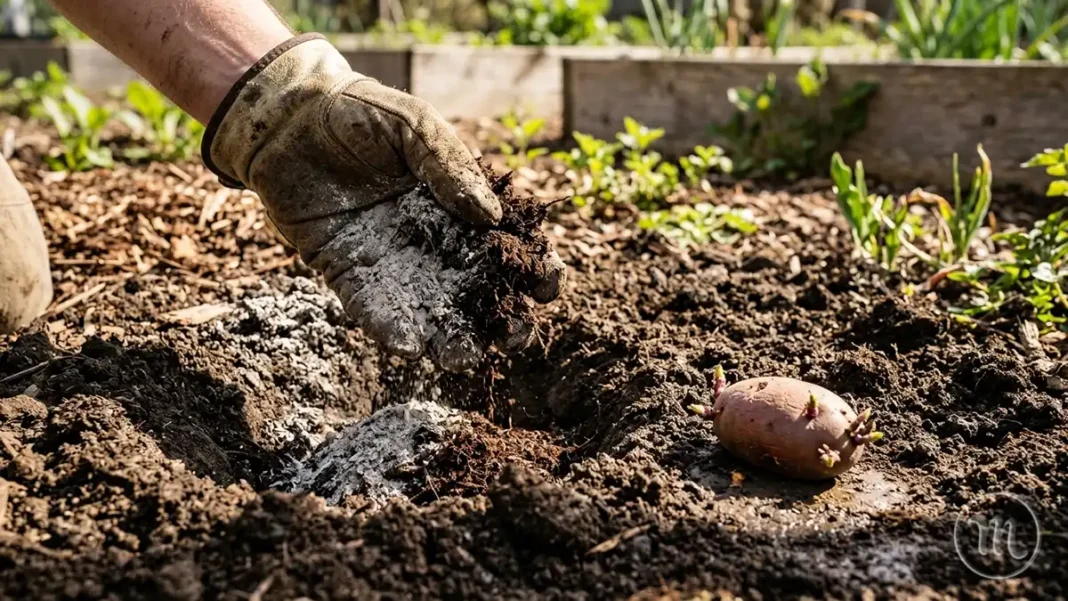
- Adding to the hole: in each prepared planting hole, pour exactly one handful of ash and two generous handfuls of compost.
- Mandatory mixing: this is the critical moment. Thoroughly mix the fertilizers with the soil at the bottom of the hole using a garden trowel or a gloved hand. You shouldn’t place the potato directly on pure ash to avoid burning the delicate roots.
- Planting: place the sprouted potato with the sprouts facing up. This ensures the fastest possible emergence of shoots to the surface.
Ash isn’t just campfire leftovers; it’s a concentrate of micronutrients. It serves as a natural source of potassium, phosphorus, calcium, and magnesium. These substances are responsible for forming large, starchy tubers and strengthening the plant’s immunity to diseases. Plus, ash slightly deoxidizes the soil, which potatoes really love.
Compost, for its part, plays the role of a “blanket” and conditioner. It enriches the earth with organic matter and improves its structure, making even heavy clay soil fluffy. Thanks to compost, moisture stays near the roots longer, and oxygen access remains constant, allowing the potatoes to “breathe” and grow actively even during summer heat.
While the ash and compost mix is a real “magic wand,” it’s worth remembering the holistic approach. Even with golden fertilizer, the harvest can fail if you ignore other details. First off, pay attention to the potato variety: some are genetically inclined to reach giant sizes, while others produce many small fruits.
The quality of the seed itself matters too — choose healthy, firm tubers without signs of disease. And, of course, don’t forget about maintenance throughout the season. Regular hilling creates extra volume for new tubers to grow, and protecting against the Colorado potato beetle helps preserve the leaves that feed the plant. We can’t change the weather, but the right feeding will help the potatoes handle both drought and excessive rain more easily.
My opinion:
I’ve seen time and again that natural fertilizers always beat store-bought chemicals when it comes to the taste and shelf life of vegetables. Adding ash and compost to the hole is that exact case where minimal effort in the spring brings a colossal result in the fall, turning an ordinary garden into a source of eco-friendly products.
Advice from MODISTA
- Use only wood ash: ash from burning plastic, painted wood, or trash can poison your future harvest with toxins.
- Before planting, be sure to sprout your potatoes in the light for 2–3 weeks so the shoots are strong and green.
- If your soil is very sandy, increase the amount of compost to three handfuls to better retain moisture and nutrients.
And what proven potato planting methods do you use on your plot? Share this article with your fellow gardeners so they can learn the secret to a royal harvest too!
ℹ️ REFERENCE
Organic farming is a method of agriculture that excludes the use of synthetic pesticides and mineral fertilizers. It is based on restoring natural soil fertility using natural components such as compost, manure, and plant ash. You can learn more about the principles of organic vegetable growing on specialized resources or on Wikipedia 🌐