



Read in another language:
- • Why a popular cheap pharmacy hack is completely useless for succulents.
- • The physiological age limits of the Crassula, below which blooming is biologically impossible.
- • How to create the perfect winter temperature regime and strict light timing.
- • Choosing the right cramped pot, specific soil, and essential mineral macroelements.
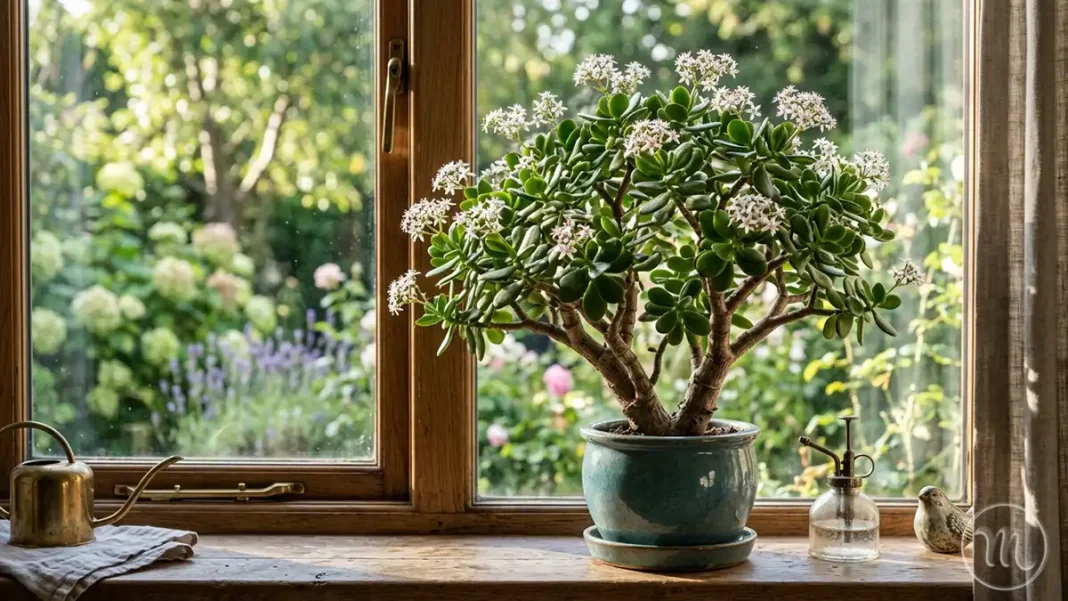
A blooming money tree, proudly known in scientific circles as Crassula or jade plant, is such an exotic and rare sight in our homes that it has sparked countless legends. The appearance of these delicate, starry white flowers has long been considered an undeniable and powerful omen of sudden, massive wealth. For years, indoor gardeners watch over their lush, green green companions on windowsills, yet the coveted buds never show up. And at that exact moment of despair, the internet starts aggressively pushing questionable “miracle” folk remedies.
The loudest and most viral myth taking over the web claims that succulent owners should run straight to their medicine cabinet. Rumor has it, dissolving just one ordinary aspirin tablet in a liter of water and feeding this elixir to your plant will work magic. Sounds catchy, ultra-cheap, and perfectly fits today’s quick-fix lifestyle. However, reality is much harsher and doesn’t forgive basic biology blunders.
The Harsh Truth About the Pharmacy Myth and Its Consequences
Dissolving a single aspirin tablet in a whole liter of water creates such a low concentration of acid that it can’t trigger beneficial stress or jumpstart the plant’s internal processes. On its own, this trick is completely pointless for flower bud initiation. But the real danger lies elsewhere: online gurus persistently advise doing this up to three times a month.
For an African succulent during its fall and winter dormancy, that much extra moisture is a direct, guaranteed death sentence due to instant root rot. Instead of a lush white bloom and financial success, you risk ending up with a mushy, dead stem in your pot. Our money tree hails from the rugged, arid regions of Africa; it’s used to constant hardships and definitely doesn’t need human medication. To make this green Spartan want to reproduce (and blooming is exactly a plant’s attempt to leave offspring), it needs expertly organized stress and our iron discipline.
Підписуйтесь, щоб не пропустити нічого цікавого! | Follow us so you don't miss anything interesting! | Subskrybuj, aby nie przegapić niczego ciekawego!
Rule 1: The Age Barrier and Cold-Blooded Patience
We live life in the fast lane, expecting instant results by tomorrow morning. But just like waiting for compound interest in a bank account, you shouldn’t expect quick dividends here. The physiology of the Crassula is wired so that it’s physically incapable of producing buds until it reaches full maturity.
This maturity phase typically kicks in between five and ten years of age. Any manipulation, fancy watering, or spraying around a young two-year-old cutting makes absolutely no practical sense. That’s why the very first tool every plant parent needs is calm, seasoned, cold-blooded patience.
Rule 2: Winter Chill, Total Darkness, and the Radiator Taboo
We tend to show love through warmth, unconsciously projecting our own comfort preferences onto indoor flora. That’s exactly why the most common and fatal mistake is leaving a Crassula to overwinter in a heavily heated room right next to a hot central heating radiator.
Optimal Wintering Regime for Crassula (November – March):
┌───────────────────────────┬───────────────────────────┐
│         Parameter         │      Required Value       │
├───────────────────────────┼───────────────────────────┤
│ Air Temperature           │ from +10°C to +15°C       │
│ Substrate Moisture        │ Absolutely bone-dry soil  │
│ Daytime Lighting          │ Maximum bright sunlight   │
│ Nighttime Mode            │ Complete, 100% darkness   │
└───────────────────────────┴───────────────────────────┘
Crassula can easily withstand short-term temperature drops down to +5°C, but on one ironclad condition: the soil ball in the pot must be dry as ash. Don’t cross the freezing point, though — at 0°C, the fleshy leaves, which act as natural water reservoirs, will simply freeze, the cells will rupture, and the green mass will turn into a shapeless jelly.
Lighting is just as critical. During the day, this cool room needs to be flooded with as much natural sunlight as possible. But at night, total darkness must reign. The plant relies heavily on the natural seasonal shortening of daylight. If the enclosed balcony or veranda where it’s wintering is lit up for hours every evening by artificial lights, its internal biological clock gets completely messed up. The succulent starts thinking it’s eternal summer and cancels bud formation altogether.
Rule 3: Too Much Comfort Completely Kills Motivation
Constant abundance makes plants lazy too, not just humans. If you repot a small Crassula into a massive, spacious bucket filled with rich, fertile soil, it’ll start living too comfortably. The plant will channel all its internal resources into growing roots to conquer those new free cubic inches of space.
Your pot for a Crassula must be tight, even slightly snug. When the roots start hitting the hard walls of the container, the plant gets a clear alarm signal that life resources are limited and it’s time to urgently think about reproduction. Choose a lean substrate — a special mix with a huge portion of coarse river sand, perlite, and small pebbles is absolutely perfect.
Of course, keeping the plant entirely without microelements isn’t the way to go either. In summer, during its active growth phase, it needs regular, targeted feeding. You can use special complex fertilizers for cacti and succulents, but always check the label first:
- Nitrogen (N) — must be kept to an absolute minimum. It only promotes rapid green growth and completely blocks blooming processes.
- Phosphorus (P) and Potassium (K) — these are the irreplaceable elements that give the plant a powerful chemical command to initiate and form flowers.
Rule 4: A Strict Dry Spell as the Main Catalyst
The bad household habit of watering every single plant on the windowsill once a week on a fixed schedule is a one-way ticket to destroying your Crassula. Evolution taught this plant to store liters of moisture in its thick leaves to survive months of drought in its native land. A constant artificial supply of water completely disrupts its natural biological rhythms. The ultimate blooming trigger for most succulents is a prolonged lack of rainfall.
During a proper cool wintering, you need to enforce an uncompromising dry spell. Give it a tiny splash of water only when the substrate has dried out completely, all the way to the bottom of the pot, and the lower leaves look slightly soft and lose their firmness. In winter, this might happen once a month, or sometimes even less. Your hand will instinctively reach for the watering can, but you’ll have to show some willpower: you won’t dry out the plant, you’ll just give it that life-saving stress.
Why Are We Breaking Down Winter Rules in May?
You might be reading this at the end of spring, thinking, “We’ve got another six months before the first winter chill, why do I need to know this right now?”. The logic here is simple: a solid foundation for future successful blooming is laid precisely during the active summer growth season. Right now, while it’s warm outside, your main task is to let the tree store up maximum energy.
Take your Crassula out into the fresh open air, give it as much direct sunlight as possible, and give it occasional doses of potassium-rich mixes. When November comes, your plant will enter its rest phase strong, healthy, and fully prepared for a Spartan regime. Real miracles in gardening aren’t the result of secret recipes or magic pills from the pharmacy. They come from a clear understanding of nature’s biological laws.
My Opinion:
Getting a money tree to bloom isn’t about magic pills; it’s about maturity and internal readiness. Just like in life, true abundance doesn’t come from rushing around. Character is forged through patience, stillness, and the right kinds of challenges. Let yourself and your plant simply grow up. True beauty takes time.
Advice from MODISTA
- Give your Crassula plenty of UV light on the balcony during summer, but introduce it to direct sun gradually to avoid leaf scorch.
- Completely stop using nitrogen fertilizers once summer ends, switching exclusively to phosphorus-potassium complexes to strengthen future buds.
- Check the soil condition in winter using a long wooden skewer — water the plant only when the stick comes out bone-dry after reaching the bottom.
Did you know that simple overwatering can completely ruin a Crassula’s chances of blooming? Bookmark this article or send it to a friend on Telegram so you can get your money trees ready for the upcoming season together!
ℹ️ REFERENCE
Crassula is a large genus of succulent plants in the stonecrop family (Crassulaceae), which includes over 300 species, most of which originate from the arid regions of Southern and Eastern Africa. The most famous representative is Crassula ovata, which earned the popular nickname “money tree” thanks to its unique leaf shape. You can explore a more detailed scientific classification and the origins of this succulent on the pages of the well-known online encyclopedia. 🌐