



In this article, you’ll learn:
- How to ensure lush Ruellia simplex blooming all season long.
- Why some states consider this beauty a dangerous aggressor and how to manage it.
- Secrets to choosing sterile varieties that won’t take over your entire garden.
- A step-by-step guide to care, propagation, and overwintering your plants.
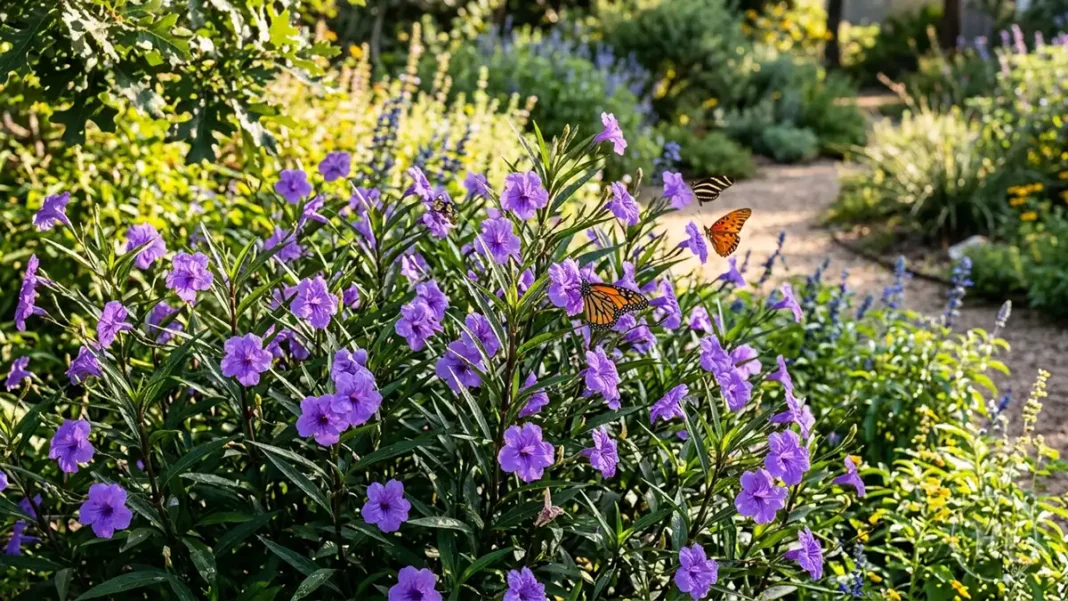
When you see a plant blooming relentlessly on a patch of packed dirt between a parking lot and a concrete wall in a rainless, scorching July, you realize — it’s a true fighter. It’s exactly for this resilience that gardeners adore the Mexican petunia. As the name suggests, this flower, also known as the Mexican bluebell or Britton’s wild petunia, hails from lands south of the border — it’s native to Mexico, western South America, and the Antilles. Today, it can be found across many southern states, Hawaii, and the Virgin Islands. In reality, it isn’t a true petunia, though its flowers look remarkably similar. Botanists argued over the name for a long time: you might see it labeled as Ruellia brittoniana, R. malacosperma, or R. tweediana, but Ruellia simplex is currently the preferred name, reports MODISTA.
This plant is quite hardy (USDA zones 8–11), reaching heights of 3 to 4 feet, and features attractive purple stems with narrow, lance-shaped leaves about 6–12 inches long. The showy blue or purple trumpet-shaped flowers are a total magnet for butterflies, hummingbirds, and bees. They appear from early summer and keep the show going until fall. It’s best to plant this beauty in the spring once the threat of frost has passed. But be careful: the Mexican petunia is an aggressive “invader” officially recognized as an invasive species in some regions. So, before bringing it into your garden, make sure it isn’t restricted in your area.
Is the Mexican Petunia Really That Dangerous?
This plant’s ability to survive anywhere has a downside — it can easily spiral out of control. Thanks to its fast growth rate, it forms massive clumps, spreading shoots that are tough to kill or remove. Its powerful horizontal rhizomes often peek above the soil surface, and its seed capsules literally explode, scattering seeds over long distances.
In humid climates and neglected areas, Ruellia simplex becomes a real headache. States like Florida, Texas, and South Carolina have added it to their invasive species lists. Some communities even have bans on planting it near nature preserves. Is it worth buying? Yes, but only if you choose modern sterile varieties that don’t produce seeds and won’t turn your garden into an unmanageable jungle.
Підписуйтесь, щоб не пропустити нічого цікавого! | Follow us so you don't miss anything interesting! | Subskrybuj, aby nie przegapić niczego ciekawego!
Care Specifics: From Sun to Watering
The Mexican petunia is surprisingly adaptable. It feels equally at home in full sun or partial shade, though it needs at least six hours of direct light a day for heavy blooming. In deep shade, the stems get leggy and thin, and you’ll see far fewer flowers.
As for the soil, this plant is almost “omnivore.” It loves fertile, well-drained, and moist spots (even boggy ones), but it’ll happily survive in sandy or dry soil too. It’s often used for rain gardens, pond edges, or simple containers. While it becomes drought-tolerant once established, the flower looks its best with regular hydration during the growing season. Mulching helps retain moisture, and a light feeding with a balanced fertilizer in spring gives the plant an extra boost.
Best Varieties and Types for Your Garden
To avoid issues with aggressive spreading, breeders have developed special cultivars. Here are a few safe options:
- ‘Katie’: A dwarf form that only grows about 10 inches tall. It produces almost no seeds and works perfectly as a groundcover.
- ‘Purple Showers’: A sterile variety with large, deep purple flowers. It doesn’t reproduce by seed, though it can spread through roots, so it’s best not to plant it in overly wet soil.
- Mayan™ Purple, Pink, and White: A series of varieties in different colors known for large blooms and absolute sterility.
- Carolina wild petunia (R. caroliniensis): A native alternative that grows up to 12 inches and is more frost-hardy.
Pruning and Propagation
When the foliage dies back after the first frost, cut the plant down to the ground. In warmer regions where it stays evergreen, pruning isn’t mandatory, but you can trim the stems after flowering to encourage new buds.
You can propagate Ruellia simplex by division, cuttings, or seeds. The easiest way is simply to cut off a piece of the rhizome with a new shoot. Cuttings about 4–6 inches long also root easily, even without rooting hormones. Just pop them into a moist substrate and cover with plastic. If you decide to grow the plant from seeds, remember they germinate best within the first six months after harvest.
Container Growing and Overwintering
Planting in a pot is the perfect way to keep the Mexican petunia in check. Choose a container about 2 inches wider than the previous one and use high-quality potting mix. If you live in a cold climate (zones 6 or 7), bring the pot indoors for the winter to a bright spot, keeping the soil moderately moist. In the spring, gradually harden off the plant before moving it back outside.
Potential Problems and Pests
The Mexican petunia is almost disease-free. Occasionally, white spots might appear on the leaves — that’s the work of tiny mites. In that case, horticultural oil or an insecticide treatment will help. If the leaves turn brown, the plant is too cold; if they turn yellow and wilt despite wet soil, it’s a sign of root rot from overwatering.
MY OPINION:
I think the Mexican petunia is a real lifesaver for lazy gardeners because its endurance is just mind-blowing. However, I always recommend choosing sterile varieties like ‘Purple Showers’ so your garden doesn’t turn into a battlefield against weeds.
Advice from MODISTA
- Always check the plant’s status in your region before planting to avoid harming the local ecosystem.
- Use confined spaces or large planters to prevent uncontrolled rhizome spread.
- Pair it with Lantana or Salvia — they have similar sun requirements and create a gorgeous visual contrast.
Are you ready to add some Mexican flair to your landscape? Share this article with your gardening friends who are looking for tough flowers for sunny spots!
Join our community where comments are open just for you!
ℹ️ REFERENCE
Ruellia simplex is a species of flowering plant in the Acanthaceae family, named after the French botanist Jean Ruel. Detailed botanical characteristics and the species’ distribution history can be found on the pages of the free encyclopedia 🌐.