



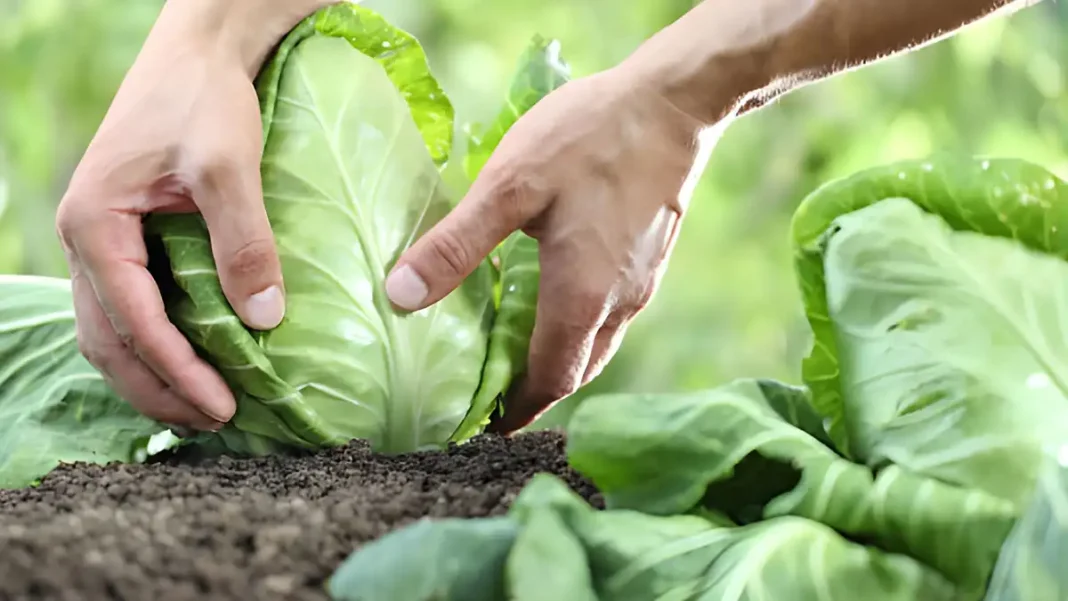
Keeping cabbage juicy, crunchy, and perfect for pickling or fresh salads all winter long is a true art. And the main secret of this art lies not in a perfect cellar or basement, but in a single decision: the correctly chosen time for harvest. We gardeners often make the mistake of relying only on a calendar date, but this approach is flawed. Cabbage, like any crop, dictates its own rules, and they depend on three key factors: the variety, the physiological ripeness of the head, and the whims of the weather.
I know from experience: the wrong day chosen — and the crop immediately starts cracking in the bed, loses quality, or, most disappointingly, quickly spoils during storage. Therefore, if you want your winter preserves to be royal, you need to learn to listen to the plant. Let’s figure out when and how to cut each variety to ensure the cabbage has a “long life.”
Harvesting Times: Dependence on the Variety
Early Varieties: Speed and Freshness
Early cabbage is our summer favorite. It ripens quickly, in 55–100 days, and is intended exclusively for immediate consumption. These heads are tender, extremely juicy, but absolutely not adapted for long-term storage. We harvest them selectively, as they ripen, usually in June-July. There is one nuance that cannot be ignored: if left in the garden after heavy rains, they may crack due to excess moisture. Therefore, their fate is to be eaten immediately, or at most within a week or two.
Mid-Season Varieties: The Universal Choice
If you need a universal option, suitable for both fresh salads and the first round of pickling, your choice is mid-season cabbage. Its vegetation period is 100–130 days. We usually harvest it in late August or September. What’s important to consider? The main thing is to finish before the onset of prolonged autumn rains. If you leave them too long, the heads may become oversaturated with moisture, which, of course, will negatively affect their integrity.
Late-Season Cabbage: Our Winter Strategic Reserve
But late-season varieties are a real strategy. We grow them specifically for long-term storage and main pickling. Their ripening period is the longest — 130–150 days or more. Here the date takes a back seat, and the signs of ideal ripeness come first:
Підписуйтесь, щоб не пропустити нічого цікавого! | Follow us so you don't miss anything interesting! | Subskrybuj, aby nie przegapić niczego ciekawego!
- Density and Weight: The head must be fully formed, dense, and heavy.
- Sound: If you tap it, it should produce a dull, ball-like sound.
- Leaves: The outer leaves become large, acquire an intense color, and a characteristic waxy coating.
- Signal: The lower leaves begin to naturally yellow, which is a clear signal: growth is complete.
Weather Decides Everything: The Ideal Time for Harvesting Late Varieties
For late cabbage, the weather is not just a condition, it is its main ally. You might be surprised, but light frosts do not harm the cabbage. On the contrary! If the temperature drops to –2…–3 °C at night and stays around +2 to +8 °C during the day, it only improves the taste of the heads.
Why? Cold triggers the natural process of converting starch into sugars. The cabbage becomes sweeter, more aromatic, and, critically, its keeping quality increases! This is a secret that our grandmothers used.
That is why the optimal time for harvesting late varieties often falls after October 14 and can last right until early November, although, of course, the exact timing will always depend on the climate of your region.
But be careful: we only need light frosts. If the forecast promises severe frosts (below –5 °C), harvesting must be done immediately. Deep freezing can damage the internal structure of the head, turning your long-awaited harvest into a soft mass unsuitable for long-term storage.
How to Harvest Cabbage: Tips for Long-Term Storage
When the ideal time has come, it is no less important to cut the cabbage correctly. This must be done carefully.
- Tool: Use a sharp knife or a hatchet.
- Stump: Cut the head so that a short stump 3–5 cm long remains.
- Protection: Be sure to leave 2–3 outer wrapper leaves. Why? They will serve as a natural protective layer that will guard the inner part of the head from moisture evaporation and mechanical damage during transportation and storage.
Do not rush after harvesting! Sorting is your next step:
- Perfect heads (dense, undamaged) — for long-term storage.
- Damaged, cracked, or too soft — immediately process, pickle, or eat them.
And the last important stage is cooling. Before moving the harvest to the storage location, the cabbage must cool down outside or in a cool shed. The best conditions for winter storage are provided in a cellar or basement at a temperature close to zero (0–1 °C) and high humidity.
Thus, a successful harvest is not just work, but careful observation of nature, the variety, and the state of the plant itself.
Harvesting cabbage is the culmination of garden work, and for the finale to be victorious, we must act not according to a schedule, but according to nature’s hints. A quality cabbage crop depends on two things: a little autumn frost for juiciness and your attentive eye that distinguishes a perfectly ripe, dense head from one that is not yet ready. By following these simple rules, you will ensure yourself a crunchy harvest until spring.