

- •Which ancient philosopher first compared a predator’s behavior to human falsehood.
- •How Christian preachers used the image of a crocodile to educate their congregation.
- •The role William Shakespeare played in popularizing this mystical myth.
We often hear the expression “crocodile tears” when someone only pretends to sympathize while secretly rejoicing in another’s misfortune. It might seem like this phrase was born just recently in psychologists’ offices, but in reality, this idiom is a true long-liver. It’s over two thousand years old, and during this time, it has managed to travel across the entire world: from the majestic Ancient Rome to today’s digital realities, reports MODISTA.
Interestingly, throughout history, the meaning of the expression has remained unchanged: it has always referred to treacherous hypocrisy and fake sorrow. However, the path this metaphor took is filled with amazing mistakes and myths. As it turns out, it’s a whimsical blend of ancient observations, scary medieval tales, and even errors by brilliant writers.
How Plutarch First Linked Humans and Crocodiles
The first person to notice this strange trait in reptiles was the ancient Greek writer and philosopher Plutarch. He lived back in the first century and noticed something very striking. The philosopher told tales that crocodiles supposedly cry bitterly when they kill their prey because hunger pushes them to commit a cruel crime against defenseless creatures. Plutarch compared these predators to people who do evil and then act as if they sincerely regret what they’ve done, hiding behind noble goals.

And so, the first metaphor in history was born. It’s worth noting that in those days, no one intended to check if tears actually flowed from a giant lizard’s eyes. Everyone simply took the authoritative ancient author at his word, accepting an artistic image as literal truth.
A Sermon on Fasting and Human Heads
Later, in the fourth century, a Christian bishop named Asterius used this vivid image to shame his congregation. He called on believers to keep the Great Lent sincerely, from the heart, not just for formality. In his speech, the bishop noted that some believers were as hypocritical as Nile crocodiles. These creatures supposedly cry when they eat the heads of the people they’ve killed. But the tears aren’t from repentance — there’s just too little meat on the head, and they’re upset that the meal turned out to be meager.
Підписуйтесь, щоб не пропустити нічого цікавого! | Follow us so you don't miss anything interesting! | Subskrybuj, aby nie przegapić niczego ciekawego!
It was such a juicy, albeit somewhat crude, image that the parishioners remembered it for life. Thus, the ancient myth finally migrated into Christian culture and took on new, more didactic colors.

A Medieval Bestseller
A huge contribution to the insane popularity of the phrase was made by an adventurous book titled “The Travels of Sir John Mandeville.” In the Middle Ages, absolutely everyone read this book — from monarchs to merchants. The author spoke of the incredible wonders of Asia and wild beasts. There, he described crocodiles as giant snakes that shed tears of deep remorse while killing a person. Furthermore, Mandeville claimed that these animals lacked a tongue, which is why they cried out of helplessness when swallowing their victim.
Of course, this was pure fiction. Crocodiles do have tongues, and they function perfectly well, and they certainly don’t cry out of pity. However, the story instantly spread across Europe, and for readers of that time, the weeping reptile became the primary symbol of a hypocritical killer.

How Shakespeare Cemented the Expression for Centuries
It was thanks to this medieval tall tale that the English playwright William Shakespeare learned about this strange phenomenon. In his time, Mandeville’s book was considered a real encyclopedia of the surrounding world. In his immortal tragedy “Othello,” the great writer placed a wrathful phrase into the protagonist’s mouth. Othello, suspecting his wife of infidelity, exclaims that if the earth could be impregnated by woman’s tears, each drop she falls would prove a crocodile.
The English adored their Bard, and after such a powerful line, the phrase “crocodile tears” stuck to the language for good. Shakespeare seemingly preserved the ancient legend, giving it a second wind.
What Really Happens to the Reptile
For centuries, people racked their brains while observing these predators. Biologists finally confirmed: when a reptile stays on the shore for a long time or bites into prey, drops really do roll from its eyes. Observers in Ancient Egypt decided the predator was just acting like a miserable victim. But modern science offers a prosaic and entirely physiological explanation for this.
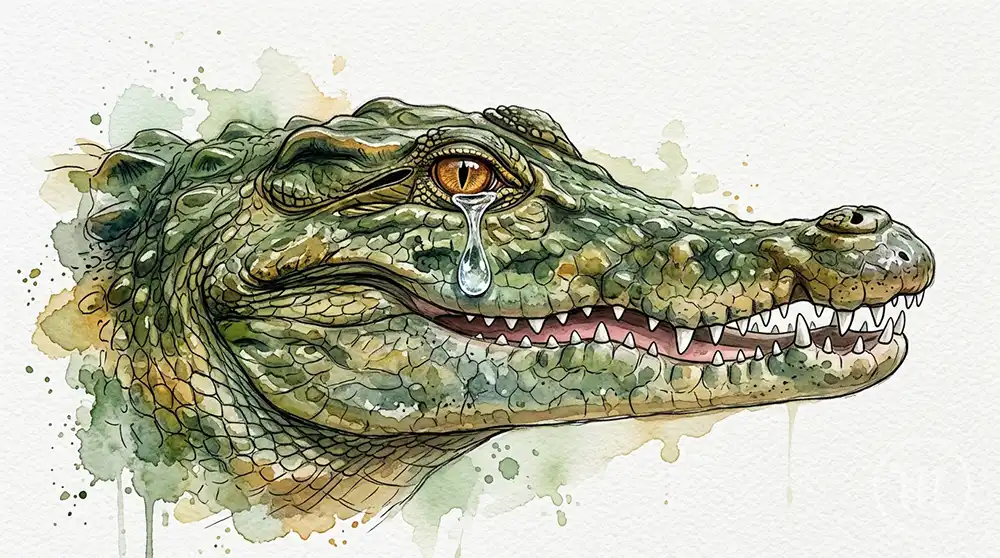
Crocodiles have special glands near their eyes that are necessary for removing excess salt from the body. It’s a kind of internal cleaning station. When the reptile is actively chewing, its muscles press against the glands, and the salty liquid simply comes out. There’s no grief here, no remorse, and no drama. It’s just pure physiology, similar to water condensation on a glass of a cold drink.
It turns out the famous expression is built on a total misunderstanding. Humans accused animals of a purely human vice — hypocrisy. But they also fell for their own imagination, attributing complex emotions to a beast. The crocodile was just having lunch, while the human saw a Shakespearean tragedy. The phrase stuck, became international, and today in any language of the world, it signifies a verdict on false sympathy.
MY OPINION:
I’ve always believed that language is a living organism where mistakes of the past become the ornaments of the present. The story of crocodile tears proves once again: we tend to see drama where simple biology is at work, but it’s precisely because of this that our communication becomes so figurative and vibrant.
Advice from MODISTA
- Use this idiom carefully, as it carries a fairly strong negative charge.
- Remember the physiological nature of the phenomenon — sometimes facts are more interesting than myths.
- Develop critical thinking so you don’t become a victim of “crocodile tears” in real life.
Have you ever met people whose “crocodile tears” seemed way too realistic? Share this article with your friends so they can also learn the truth about this legendary idiom!
ℹ️ REFERENCE
Crocodile tears is a stable idiom meaning insincere, fake sympathy or remorse. The expression is based on an ancient myth that crocodiles cry while eating their prey. You can learn more about the history of the origin of expressions on Wikipedia pages 🌐.
MODISTA Daily MODISTA Daily MODISTA Daily
Наші стандарти: | Our standards: | Nasze standardy: Редакційна політика сайту MODISTA | Editorial policy of the MODISTA website | Polityka redakcyjna serwisu MODISTA
За матеріалами Modistaua.com | Based on materials from Modistaua.com | Na podstawie materiałów Modistaua.com
Підписуйтесь на новини | Subscribe to news | Subskrybuj wiadomości MODISTA в Telegram