




In this article, you’ll learn:
- Which official labels help identify AI content on popular platforms.
- Why strange body language and human movements in videos are a red flag.
- How visual “glitches” and artifacts unmistakably betray a digital fake.
- What out-of-sync audio and video indicates.
- Why independent fact-checking remains the most reliable method.
With the surging popularity of neural networks like Google’s Veo and other powerful models, the internet’s literally been flooded with realistic videos that aren’t always what they seem. As a journalist who’s constantly working with technology, I’m seeing this trend firsthand. Some clips are made for fun, while others are designed for dangerous manipulations capable of misleading millions. It’s not just a joke anymore; it’s a tool that can influence public opinion and even political stability, reports MODISTA.
In today’s world, where information spreads at lightning speed, knowing how to tell a digital fake from real footage is becoming essential. It isn’t paranoia—it’s digital hygiene. Tech developers and social networks are trying to implement labeling tools, but as users, we’ve got to stay one step ahead. Understanding AI’s technical flaws is your main ace in the hole against fake news. Let’s break down what I look for first.
Official Labels and Tags: The First Line of Defense
The first thing I do when I spot a suspicious video is look for official marks. It’s the simplest and most reliable way. Major platforms like Meta and YouTube have already introduced rules requiring creators to label content made with AI. For example, YouTube requires disclosure for “synthetic media” if the video looks realistic. Often, clips generated by models like Veo 3 have subtle watermarks as part of a transparency policy. This is the first and most obvious filter you shouldn’t ignore.
Unnatural Movement and Body Language: When the Body Lies
Next, I take a close look at the people in the frame. Artificial intelligence still struggles to replicate complex human biomechanics. If someone moves too smoothly, like a robot, or conversely, if their movements are blurry and twitchy—that’s a serious reason for doubt. AI “slips up” most often on the small details: weird facial expressions while eating, unnatural blinking, and especially hands. Merging fingers, extra limbs, or their strange shapes are classic mistakes of many generative models. I’ve noticed that’s where the algorithms break down most frequently.
Підписуйтесь, щоб не пропустити нічого цікавого! | Follow us so you don't miss anything interesting! | Subskrybuj, aby nie przegapić niczego ciekawego!
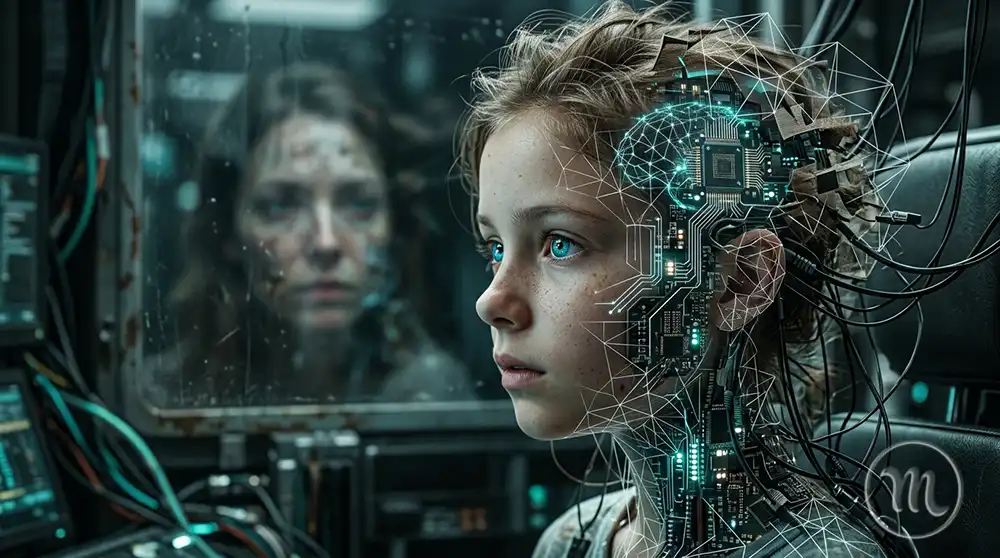
Objects Appearing Out of Nowhere: Visual Artifacts
One of the most noticeable algorithm errors is the instability of objects in the frame. It’s what I call “digital ghosts.” You might see an object on a table suddenly vanish, change shape, or smoothly “melt” into another part of the background. These visual artifacts are direct proof that the video was generated, not captured on camera. Slow down the playback and watch the background carefully—that’s often where the most obvious glitches hide.
Audio-Visual Desync: When Words Don’t Match the Lips
Video generation tech doesn’t always perfectly sync the audio track with the visuals. A classic sign of digital manipulation is when a speaker’s lip movements don’t match the words they’re saying. This visual dissonance often gives away a low-quality deepfake. It’s also worth paying attention to background noise. Imagine a video set on a busy street, but instead of the roar of cars and people chatting, you hear almost total silence or strange, out-of-place sounds. AI’s inability to correctly replicate contextual noise is another red flag.
Independent Fact-Checking: Your Main Tool
If the visual signs leave you with doubts, the best method remains good old-fashioned fact-checking. This is my favorite part of the investigation. If a video covers a high-profile event, look for info in reliable sources. A few minutes of Googling or checking official news sites can save you from spreading a masterfully crafted illusion. Remember: content that’s too shocking or emotional is often a fake designed for viral spread.
My Opinion:
I’ve tested dozens of AI generators, and I can say one thing: the technology is developing at a breakneck pace, but the human eye is still able to catch the mistakes. The main thing is not to lose your vigilance and always question content that’s “too amazing” to be true. Critical thinking is our best weapon in the age of deepfakes.
Advice from MODISTA
- Take a screenshot. Use Google Image Search to check if this frame appeared previously in a different context.
- Check the comments. Often, it’s the community that first spots signs of a fake and discusses them under the video.
- Slow down the playback. Watching at 0.25x speed lets you spot artifacts that are invisible at normal speed.
Have you already come across videos that turned out to be the work of a neural network? Share this article with your friends so they stay informed and don’t fall victim to digital manipulation.
ℹ️ REFERENCE
Deepfake is a technique for human image synthesis based on artificial intelligence. It’s used to combine and superimpose existing images and videos onto source images or videos. The name comes from a combination of the terms “deep learning” and “fake.” The technology allows for the creation of extremely realistic but entirely fabricated videos where a person can say or do things they never actually did. 🌐