



- • How maintaining the right cane density saves your berry patch from exhaustion and tiny fruits.
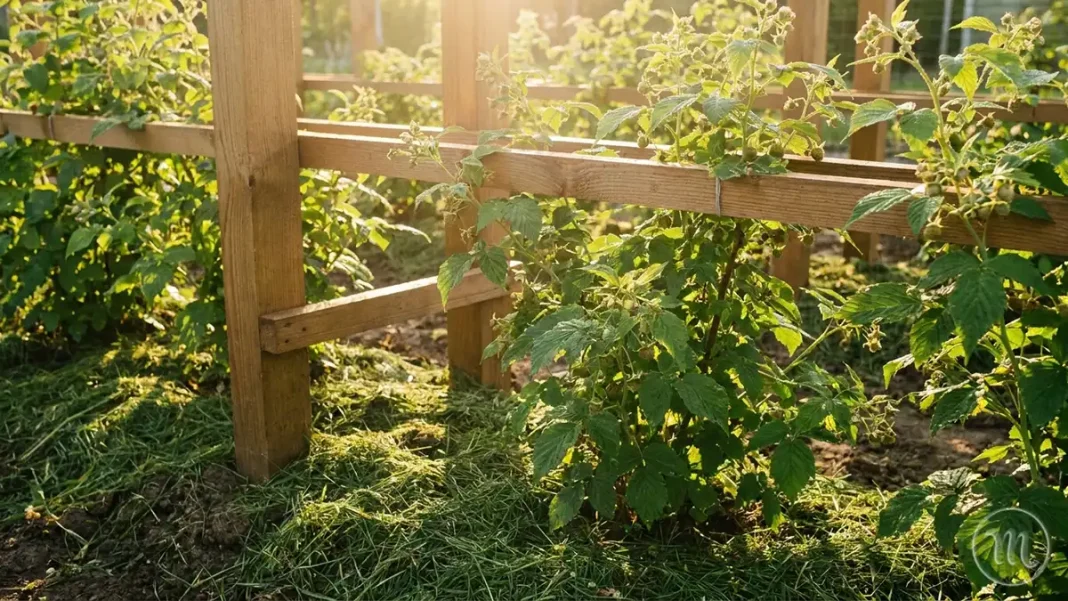
- • The secrets of grass clipping mulching to lock in precious moisture right at the roots.
- • The golden rule of May nitrogen, phosphorus, and potassium feeding for maximum sugar accumulation.
- • Safe timelines and products to protect your raspberries from pests and diseases without harming pollinators.
Read in another language:
When your berry bushes get overly crowded, the fruit almost always ends up small, tart, and sparse. This happens because the patch wastes all its energy and vital nutrients feeding extra, useless canes, completely forgetting about actual fruit production. To get those big, sweet berries, timely thinning is absolutely essential. Ideally, you should leave a bush formed with just 5–8 of the strongest canes if you are growing your raspberries using the traditional hill system, reports MODISTA.
If they are growing in a continuous row on a classic trellis system, the golden rule is to keep about 10–12 sturdy canes per linear meter. This approach also does wonders for preventing unwanted shading. Raspberries love soaking up direct sunlight for at least 6 hours a day. If your bushes are hiding in the heavy shade of nearby trees, it’s time to carefully thin out the overhead canopy. In permanent shade, the crop simply won’t accumulate enough sugars to give you that rich, sweet flavor.
Smart Mulching and Watering Habits
Since these plants have a very shallow root system, they absolutely love moisture and react to drought instantly. Traditionally, gardeners are advised to water deeply starting in May, pouring up to 10 liters of water per mature bush. However, you should always check the actual weather conditions first: if it’s a rainy May, watering blindly on a strict schedule will only do harm. In that case, the roots will suffocate from waterlogging or pick up dangerous fungal infections.
Checking the real need for moisture is incredibly simple: if the soil under the mulch feels damp at a depth of 5–10 cm, skip the watering can. To cut down on tedious chores and protect those delicate roots from drying out, it is highly effective to lay down a fresh layer of grass clipping mulch. The ideal protective barrier should be up to 7 cm deep, but make sure to leave a 3–4 cm gap around the canes to prevent the bark from rotting. Trust me on this—the results of this simple step will blow you away when harvest time comes around.
Підписуйтесь, щоб не пропустити нічого цікавого! | Follow us so you don't miss anything interesting! | Subskrybuj, aby nie przegapić niczego ciekawego!
Feeding Your Raspberries in May
A smart fertilizer routine is done in two distinct phases—at the beginning and at the very end of the month. First, the plants need an effective boost of nitrogen. This can come from natural organic options like nutrient-rich weed teas or high-quality compost. These fertilizers do a fantastic job stimulating lush green growth, large leaves, and strong new replacement canes. The main thing here is not to overfeed them; otherwise, the bushes will start producing nothing but leaves at the expense of your future harvest, and the berries themselves will turn watery and rot quickly.
By the end of the month, balanced mineral mixes packed with phosphorus and potassium become pure gold for your berry patch. Potassium, combined with plenty of sunlight, is directly responsible for sugar accumulation in the fruit, delivering that luxurious sweet taste and great density, which is crucial if you want berries that don’t mush up during transport. For this stage, potassium monophosphate or similar modern fertilizers with a high, readily available content of these elements work perfectly.
Protecting Your Patch from Sneaky Diseases and Pests
In May, tried-and-true products like “Chorus” or “Topas” are most commonly used to provide reliable protection against widespread diseases. But there is one critically important rule you must follow without question: any treatment with chemical fungicides must be done strictly before blooming begins, during the active budding stage. If you accidentally spray raspberries that are already in flower, you could easily poison bees and other pollinators, and without their hard work, you won’t get a decent harvest at all.
If you don’t see any obvious symptoms of infection or dark spots on the leaves, you can easily stick to safe biological fungicides, like the popular “Fitosporin-M.” As for the pests waking up under the warm sun, eco-friendly, gentle solutions like “Lepidocide” and “Fitoverm” handle them beautifully. With this kind of comprehensive care, your raspberries will grow strong, resilient, and healthy, making your summer harvest truly massive, sweet, and absolutely delicious.
My Opinion:
Caring for a garden is always about learning to listen to nature rather than just blindly following dry instructions. Raspberries thrive where there is respect for their space, sunlight, and moisture balance. A truly generous harvest is born from our attentiveness. Give your garden some love.
Advice from MODISTA
- Always leave a small gap around the canes when spreading grass clippings to avoid trapping moisture and rotting the base.
- Do all your bush spraying exclusively in the evening or on cloudy days to protect the leaves from nasty sunscald.
- Don’t skip biological products during the budding stage—it’s the absolute best way to protect future berries without harsh chemicals.
How do you handle crowded raspberry bushes in your garden? Bookmark this article so you don’t miss the deadline for that crucial late-May potassium boost!
ℹ️ REFERENCE
The European raspberry (Rubus idaeus) is a well-known deciduous shrub in the rose family, widely cultivated for its sweet, red edible berries. Achieving consistently high yields requires regular maintenance, including pruning, mulching its shallow root system, and protecting it from fungal diseases during the spring season. You can learn more about the biological traits and cultivation of berry-producing shrubs on the pages of the free encyclopedia. 🌐