



A leading Harvard University professor, Avi Loeb, has put forth an exceptionally bold hypothesis regarding the nature of the enigmatic interstellar object known as 3I/ATLAS, which is currently traversing our Solar System. This object has become the subject of intense scientific debate, the climax of which is anticipated on October 29, 2025. This is the day when, during its closest approach to the Sun, it is expected to reveal its true nature, either confirming or refuting the theory of its possible extraterrestrial technological origin, reports MODISTA.
According to classical astronomical understanding, when a comet approaches the Sun, solar radiation heats its icy nucleus. This causes the sublimation of volatile substances, notably water and carbon dioxide, which turn directly into gas. Such thermal stress often leads the comet to fragment into numerous smaller pieces, as reported by T4.
Professor Loeb predicts exactly such a scenario for 3I/ATLAS if the object is entirely natural in origin. However, he estimates the probability of this object being a technological artifact, disguised as a celestial body, to be at 30–40 percent.
The “Mothership” Scenario
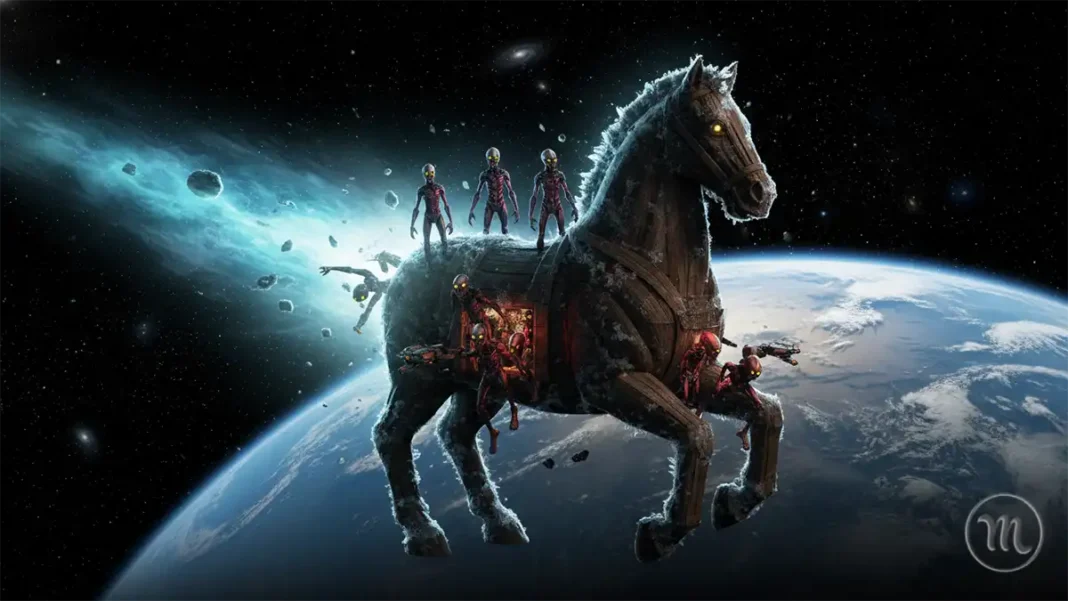
Should 3I/ATLAS prove not to be a natural comet, Professor Loeb hypothesizes it might behave like a technological “mothership.” Instead of disintegrating under thermal load, this object could, conversely, release a small fleet of mini-probes. These probes, according to his theory, could be designed to explore our Solar System, effectively making the object a kind of “Trojan Horse” from an extraterrestrial mission.
International Observation
This unique celestial phenomenon is under the close scrutiny of the global scientific community. Notably, the European Space Agency’s (ESA) Jupiter Icy Moons Explorer (Juice) probe will have the opportunity to observe the event from a close distance, recording any changes.
Підписуйтесь, щоб не пропустити нічого цікавого! | Follow us so you don't miss anything interesting! | Subskrybuj, aby nie przegapić niczego ciekawego!
Throughout November and December, ground-based telescopes will also be focused on 3I/ATLAS. They aim to confirm whether the object will break up into fuzzy specks of light, like a common comet, or if distinctly delineated, purposeful objects will detach from it—which would provide crucial evidence supporting Professor Loeb’s hypothesis.